

Dutch Grand Prix 2026 Predictions became especially interesting after the race because several of the factors identified before the weekend genuinely influenced the final result. Lando Norris ultimately won at Circuit Zandvoort, Kimi Antonelli finished second, and George Russell completed the podium, while Max Verstappen’s home Grand Prix ended with a first-lap crash.
The original Dutch Grand Prix 2026 Predictions focused heavily on qualifying position, recent form, tyre management, Sprint adaptation, and the difficulty of overtaking at Zandvoort. Looking back after the event, those themes proved far more important than simply relying on historical results or championship reputation.
Norris arrived at the Dutch Grand Prix with momentum after winning in Hungary and immediately showed that McLaren had serious pace. He qualified on pole with a lap of 1:11.163, ahead of Russell in second and Antonelli in third. Oscar Piastri lined up fourth, Lewis Hamilton fifth, Charles Leclerc sixth, and Verstappen only seventh.
That starting order immediately changed the way the Dutch Grand Prix 2026 Predictions needed to be viewed.
At Circuit Zandvoort, qualifying carries unusual importance. The track is narrow, fast in several sections, and highly dependent on driver confidence through banked corners and rapid changes of direction. Overtaking is possible, but it is considerably more difficult than at circuits with long straights and heavy braking zones.
Starting from pole therefore gave Norris more than just a numerical advantage. It allowed McLaren to dictate the opening phase rather than forcing the team to recover through traffic.
Dutch Grand Prix 2026 Predictions and the Importance of Qualifying
The strongest evidence supporting the original Dutch Grand Prix 2026 Predictions came from qualifying itself.
Norris took pole by just over a tenth of a second from Russell, while Antonelli was only 0.031 seconds behind his Mercedes team-mate. Piastri was also extremely close in fourth. The margins at the front showed that McLaren and Mercedes were operating in a very similar performance window.
That mattered because Zandvoort tends to magnify small differences.
A tenth of a second in qualifying can separate clean air from traffic, and once a driver becomes trapped behind another car, tyre temperatures and aerodynamic balance can quickly become more difficult to manage.
The Dutch Grand Prix 2026 Predictions therefore had to place significant weight on Saturday rather than focusing only on theoretical Sunday race pace.
Norris converted that qualifying advantage into an early race lead, while Russell and Antonelli remained positioned closely enough to challenge if McLaren made a mistake.
Verstappen faced the opposite problem.
His seventh-place starting position meant he needed to recover several places before he could realistically fight for victory. Considering his outstanding historical record at Zandvoort, that was one of the biggest contrasts between reputation and actual weekend performance.
The race then changed dramatically before that recovery could even begin.
Verstappen’s Crash Changed the Entire Race
Max Verstappen’s home Grand Prix lasted only one racing lap.
Norris led away from pole, but Verstappen lost the rear of his Red Bull and hit the barriers, triggering a red flag. Formula 1 later confirmed that he was unharmed.
That incident instantly removed one of the most prominent names from the Dutch Grand Prix 2026 Predictions discussion.
Before the race, Verstappen remained impossible to ignore because of his Zandvoort history. He had won the Dutch Grand Prix three consecutive times between 2021 and 2023 and had repeatedly demonstrated exceptional confidence at the circuit.
But the 2026 race illustrated exactly why historical performance should never be treated as a guarantee.
His previous victories could not compensate for a weaker starting position, a different competitive order, or a first-lap incident.
That is an important distinction when evaluating any Dutch Grand Prix 2026 Predictions retrospectively. Historical trends can identify drivers who are comfortable at a circuit, but they cannot eliminate race-day uncertainty.
Antonelli Briefly Turned the Race Around
When the race restarted, Kimi Antonelli produced one of the most important moments of the afternoon.
The Mercedes driver made an excellent restart and passed Norris for the lead. From there, Antonelli began building an advantage and briefly appeared capable of taking control of the Grand Prix.
That phase supported another important element behind the Dutch Grand Prix 2026 Predictions: Mercedes had arrived at Zandvoort with genuine winning pace.
Antonelli was already leading the championship entering the weekend, but championship position alone was not what made him dangerous. Mercedes had demonstrated strong performance across multiple circuit types during the first half of the season, and Zandvoort confirmed that the car could also perform on a narrow, high-load circuit.
The restart gave Antonelli track position, and at Zandvoort that is extremely valuable.
For several laps, Norris had to follow rather than control.
That created a different tactical challenge. Instead of pushing immediately and risking excessive tyre wear, Norris stayed close enough to remain strategically relevant while allowing the race to develop.
The final outcome would eventually reward that patience.
Why Norris Was Still the Strongest Candidate
Although Antonelli led after the restart, Norris never disappeared from the picture.
His pace remained strong enough to keep Mercedes under pressure, and as the Grand Prix entered its final third, he began closing the gap. Eventually, Norris regained the lead and moved back into control.
That progression showed why the most useful Dutch Grand Prix 2026 Predictions needed to consider more than one phase of the race.
Qualifying speed helped Norris start first.
Race pace allowed him to remain close after losing the lead.
Tyre management helped him avoid compromising the later stages.
And strategic patience gave McLaren the opportunity to attack when the balance moved back in Norris’s favour.
His eventual victory was therefore not simply the result of starting from pole.
It was the product of a complete weekend.
The Sprint Had Already Warned How Close the Battle Was
Before Sunday’s Grand Prix, the Sprint had already provided important information about the competitive order.
George Russell started the Sprint from pole and converted that position into victory over Charles Leclerc and Norris. Antonelli finished fourth, Piastri fifth, and Verstappen sixth.
Russell’s Sprint performance was particularly useful when reassessing the Dutch Grand Prix 2026 Predictions.
Mercedes was not simply collecting points through consistency. The team had real front-running speed.
Russell had qualified first for the Sprint with a 1:11.567, while Norris was only 0.041 seconds behind him. Leclerc, Piastri, and Antonelli were also separated by relatively small margins.
That compact order suggested that Sunday could not realistically be reduced to one overwhelming favourite.
McLaren had pace.
Mercedes had pace.
Ferrari remained competitive.
And Verstappen’s circuit history still made Red Bull relevant despite the weaker grid position.
This was precisely the kind of weekend where Dutch Grand Prix 2026 Predictions needed to account for multiple realistic scenarios rather than one simple expected outcome.
Circuit Zandvoort Rewarded Complete Execution
Circuit Zandvoort once again demonstrated why Formula 1 races here can be so difficult to predict.
The track combines fast corners, elevation changes, banking, narrow sections, and very little margin for error. Drivers need confidence, but excessive aggression can quickly create tyre or balance problems.
That made the Dutch Grand Prix 2026 Predictions especially dependent on execution.
Norris had to manage both the psychological pressure of losing the lead and the technical challenge of staying close without damaging his tyres.
Antonelli had to defend track position while maintaining enough pace to prevent McLaren from responding.
Russell had to stay within podium range while reacting to a race that had already been reshaped by the red flag.
Each of those drivers handled the weekend well enough to finish inside the top three.
That final podium was not random.
It reflected the three drivers and teams that executed the race most effectively after the early disruption.
How Tyre Management Shaped the Dutch Grand Prix 2026 Predictions
Tyre behaviour was one of the most important variables behind the Dutch Grand Prix 2026 Predictions, and the race confirmed why.
Zandvoort places high lateral loads on the tyres through its long, fast corners and banked sections. Drivers who push too aggressively early in a stint risk losing performance later, especially when following another car closely.
That is exactly why Norris’s patience became so important.
After Antonelli moved ahead, Norris did not immediately force a risky attack. He stayed within range, controlled his tyre temperatures, and waited for the race to shift back toward him. That approach allowed McLaren to preserve enough performance for the decisive phase.
The Dutch Grand Prix 2026 Predictions therefore needed to consider not only which car was fastest, but which driver could manage a full stint without losing too much pace.
Antonelli also managed his tyres well, but the balance eventually moved in Norris’s favour.
That difference became one of the main reasons the race turned back toward McLaren.
Why Track Position Mattered So Much at Zandvoort
Track position remained one of the strongest themes throughout the weekend.
Circuit Zandvoort does not offer the same overtaking possibilities as circuits with long straights and heavy braking zones. Drivers can remain faster than the car ahead without necessarily finding an easy way past.
That made qualifying and restart execution central to the Dutch Grand Prix 2026 Predictions.
Norris benefited from starting first.
Antonelli benefited from taking the lead after the restart.
Russell remained in podium contention because he had started near the front and avoided unnecessary problems.
Verstappen, meanwhile, was already under pressure after qualifying only seventh.
Those examples show why starting position cannot be treated as a minor detail at Zandvoort.
A strong car starting in traffic may spend too much time behind slower machinery, while a driver beginning on the front two rows gains strategic flexibility immediately.
Russell Confirmed Mercedes Had Genuine Race Pace
George Russell’s third-place finish added another important layer to the Dutch Grand Prix 2026 Predictions.
Mercedes had already shown its speed during the Sprint, where Russell won from pole. His podium in the main race confirmed that the team’s performance was not limited to one session.
Russell remained competitive throughout the weekend and avoided the mistakes that can quickly destroy a race at Zandvoort.
His result also reinforced the broader picture of Mercedes in 2026.
Antonelli finished second.
Russell finished third.
Together, they gave Mercedes two cars on the podium at a circuit where qualifying, tyre management, and confidence were all extremely important.
That consistency strengthened the argument that Mercedes had one of the most complete packages of the weekend.
Why Verstappen’s Record Could Not Predict the 2026 Result
Before the race, Verstappen’s Zandvoort history naturally carried weight.
He had won three consecutive Dutch Grands Prix after the circuit returned to Formula 1 and had repeatedly shown exceptional confidence at his home track.
However, the Dutch Grand Prix 2026 Predictions could not rely on history alone.
The competitive order had changed.
McLaren had won the previous two Dutch Grands Prix.
Mercedes entered the 2026 weekend with strong championship form.
And Verstappen started from only seventh.
His first-lap crash made the contrast even clearer.
Historical success can highlight circuit familiarity, but it does not override current qualifying position, car performance, or race incidents.
That is one of the most useful lessons from the Dutch Grand Prix 2026.
What the Dutch Grand Prix 2026 Predictions Got Right
Looking back after the race, several themes from the original Dutch Grand Prix 2026 Predictions were validated.
Qualifying proved decisive.
Recent form mattered.
Mercedes and McLaren were both genuinely competitive.
Tyre management influenced the fight at the front.
Track position remained extremely valuable.
The Sprint format also played a role because teams had less traditional practice time before competitive sessions began.
The biggest uncertainty was Verstappen.
His historical record suggested that he remained an important contender, but the race ended before he had any opportunity to recover from his weaker starting position.
That does not make the pre-race analysis meaningless.
Instead, it shows the difference between probability and certainty.
Good Dutch Grand Prix 2026 Predictions can identify the strongest drivers, teams, and strategic factors, but they cannot remove the unpredictable nature of Formula 1.
The Final Podium Reflected the Strongest Weekend Performers
The final podium featured three drivers who had been competitive throughout the weekend.
Norris had pole position and strong race pace.
Antonelli demonstrated excellent restart performance and briefly led.
Russell had already won the Sprint and remained consistently competitive in the Grand Prix.
That made the finishing order easier to understand when viewed through the entire weekend rather than only the final 72 laps.
The Dutch Grand Prix 2026 Predictions ultimately worked best when they combined qualifying, Sprint performance, recent form, and circuit characteristics.
No single statistic explained the race.
The result came from several factors working together.
What the Dutch Grand Prix 2026 Predictions Revealed
The biggest lesson from the Dutch Grand Prix 2026 Predictions was that Zandvoort rewarded complete execution rather than reputation alone.
Norris combined qualifying speed, tyre control, patience, and race pace. Antonelli proved Mercedes could challenge for victory, while Russell confirmed the team’s consistency with another podium. Verstappen’s early retirement showed how quickly an apparently strong scenario can disappear in Formula 1.
That is why Dutch Grand Prix 2026 Predictions should always be treated as informed analysis rather than certainty. Circuit history, recent form, qualifying pace, and strategy can identify realistic contenders, but incidents and changing race conditions remain impossible to predict completely.
Final Dutch Grand Prix 2026 Analysis
Looking back at the weekend, several parts of the original Dutch Grand Prix 2026 Predictions were supported by what happened on track.
Qualifying mattered enormously. McLaren and Mercedes were the strongest teams across the key sessions. Tyre management influenced the fight for victory, and Zandvoort’s narrow layout increased the value of clean air and track position.
Norris ultimately produced the most complete performance and deserved the victory. Antonelli and Russell ensured Mercedes left Zandvoort with two podium places, while Verstappen experienced the opposite extreme of Formula 1: a home weekend ending before a recovery could even begin.
The final result also reinforced an important principle for future race analysis. Strong Dutch Grand Prix 2026 Predictions came from combining data with circuit context, rather than relying on one statistic or one driver’s historical record.
More Motorsport Analysis and Official Dutch Grand Prix Resources
Continue our motorsport coverage with the MotoGP Aragon 2026 Predictions.
You can also explore the Spanish Grand Prix Predictions 2026 and our Azerbaijan Grand Prix 2026 Predictions.
For broader race coverage, visit the Digital World Pulse Sports section.
Official weekend information is available through the Formula 1 Dutch Grand Prix page and the official Circuit Zandvoort website.
Explore the Dutch Grand Prix 2026 Prediction Report
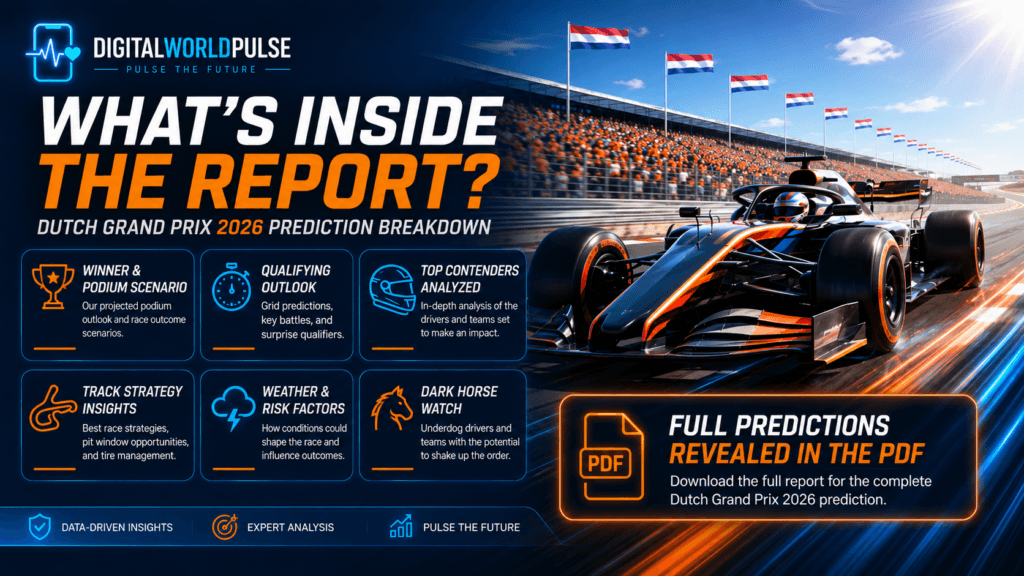
The accompanying Dutch Grand Prix 2026 Prediction Report preserves the wider pre-race analysis behind the weekend, including contender evaluations, qualifying expectations, Circuit Zandvoort characteristics, strategic scenarios, and the factors we considered most likely to influence the result.
It also provides additional context around the drivers who entered the weekend as realistic victory candidates and explains how track position, tyre behaviour, Sprint preparation, and changing conditions shaped the original race outlook.
For readers comparing the original Dutch Grand Prix 2026 predictions with what actually happened on track, the report offers a useful snapshot of the information and expectations available before the race unfolded.

Disclaimer
This article is provided for informational and entertainment purposes only. All sports predictions, opinions, and match assessments published by Digital World Pulse reflect independent editorial analysis based on available statistics, recent form, matchup context, and information available at the time of publication.
Digital World Pulse is not a bookmaker, does not accept wagers, and does not sell betting tickets. Predictions are analytical opinions rather than guaranteed outcomes, and sports results can always be influenced by unexpected factors.
If you choose to participate in sports betting, please do so responsibly, only with money you can afford to lose, and only if you meet the legal age requirements in your jurisdiction. Always follow the gambling laws and regulations applicable where you live.
Help Us Create More Valuable Resources
Digital World Pulse creates practical guides, in-depth analysis, useful tools, and downloadable resources available to everyone. Every article and resource requires time, research, hosting, and ongoing development.


If you found this sports analysis helpful, you can support our work through PayPal or Revolut. Your contribution is completely optional, and any amount—even the price of a coffee —helps us remain independent and continue creating useful, high-quality sports analysis and free resources.
Thank you for supporting Digital World Pulse and helping us continue creating independent sports analysis and free resources.
Our sports analysis is based on official league and team information, verified schedules, recent performance data, injury reports, matchup context, and other relevant sources available at the time of publication.
Yes. Injuries, player availability, lineup changes, suspensions, and other material updates are considered when they are relevant to the matchup.
Yes. Predictions and projected outcomes may be updated when important information changes, including injuries, lineups, weather, schedules, or other event conditions.
No. Projected scores and predictions are editorial assessments based on available information and are provided for informational and entertainment purposes only.
We use official league and team sources, verified schedules, recent performance data, injury reports, historical context, and reputable sports reporting where appropriate.