
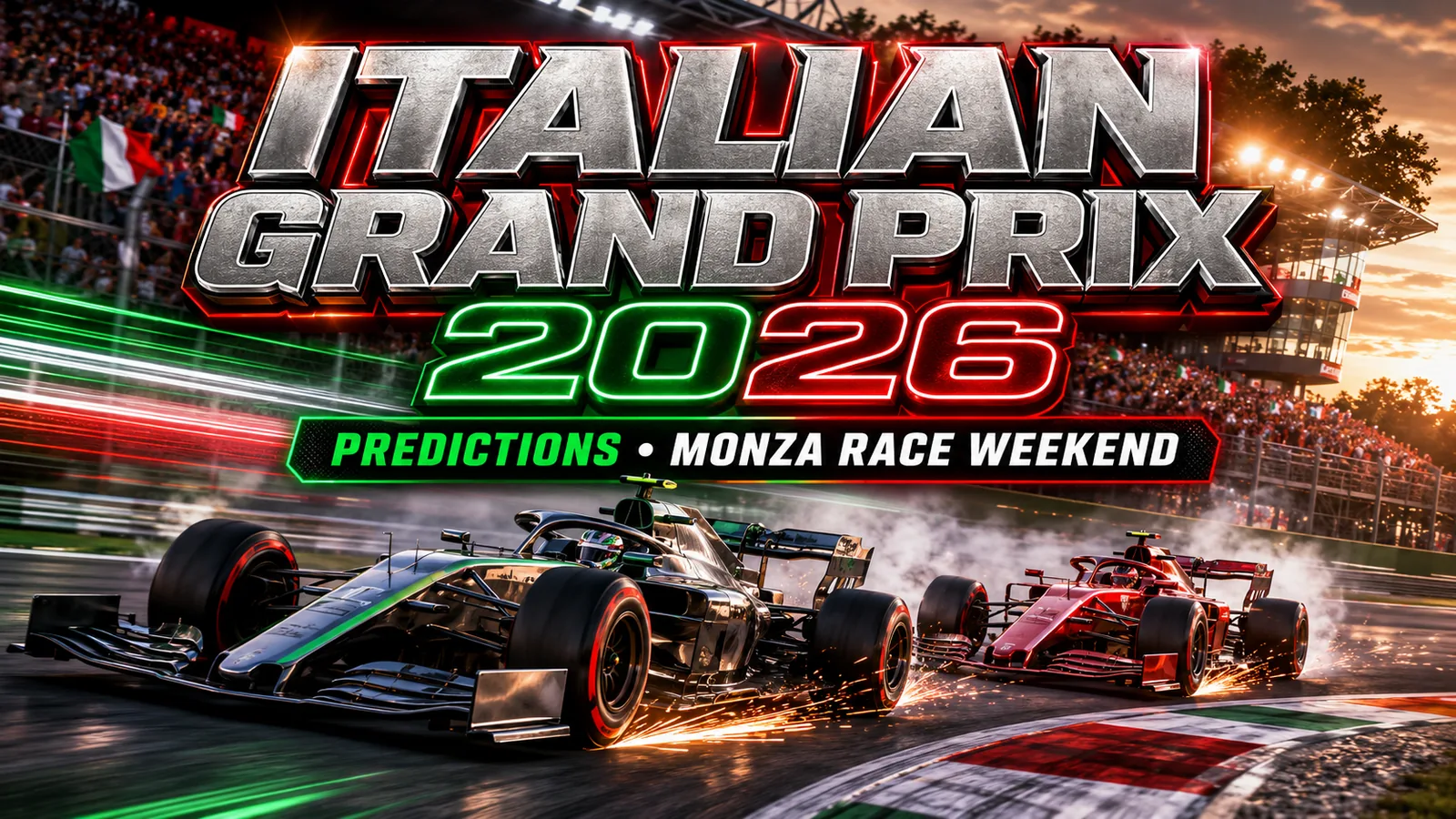
The Italian Grand Prix 2026 Predictions became far more interesting once the race was complete. Monza produced one of the most dramatic results of the Formula 1 season, with Kimi Antonelli recovering from 19th on the grid to win in front of the Italian crowd, while George Russell and Max Verstappen completed the podium.
The weekend also delivered an unexpected qualifying story. Pierre Gasly took pole position with a 1:21.786 lap, ahead of Russell, while Antonelli’s grid penalty forced Mercedes to approach Sunday from two completely different strategic positions.
The original Italian Grand Prix 2026 Predictions report was created before qualifying and the race using the information available at that time: recent form, circuit compatibility, straight-line efficiency, braking stability, tire behavior, qualifying potential and possible strategic scenarios.
The retrospective article now allows those expectations to be compared with what actually happened across one of the most unpredictable Monza weekends of recent years.
Italian Grand Prix 2026 Predictions: Antonelli Wins From P19
Kimi Antonelli produced the defining performance of the Italian Grand Prix.
Starting 19th after an engine-related grid penalty, the Mercedes driver appeared to face a recovery race rather than a realistic fight for victory.
Instead, he methodically moved through the field and remained patient during the opening stages.
That decision mattered.
Monza creates enormous temptation for a driver starting near the back to gain several positions immediately, especially on the run toward the opening chicane. But the first lap also carries significant risk because cars arrive at extremely high speed before compressing into one of the tightest braking zones on the circuit.
Antonelli avoided unnecessary contact and allowed his race to develop.
For the Italian Grand Prix 2026 Predictions, this became one of the clearest examples of why a driver does not need to win a comeback race in the opening ten laps.
He needed to stay close enough for strategy and race pace to become relevant later.
That is exactly what happened.
Why Antonelli’s Recovery Worked
The comeback was built on several factors rather than one spectacular moment.
Mercedes had enough straight-line efficiency for Antonelli to attack without sacrificing too much speed in the braking zones.
His car remained stable enough to complete repeated overtaking moves.
And most importantly, he protected the tires sufficiently to remain strategically flexible.
A driver starting 19th can easily destroy a race by forcing early moves and overheating the tires.
Antonelli did not.
The Italian Grand Prix 2026 Predictions had placed significant weight on braking stability and low-downforce confidence, and those qualities became extremely important during his recovery.
Monza rewards drivers who can brake late without losing the rear of the car.
Antonelli repeatedly needed that confidence while moving through traffic.
The Virtual Safety Car Became the Turning Point
The most important strategic moment came when the Virtual Safety Car changed the pit-stop calculation.
Mercedes used the opportunity to fit Antonelli with fresher medium tires at a reduced time cost.
That decision transformed the final phase of the race.
Before the VSC, Russell had the clearer track-position advantage.
After Antonelli’s stop, the balance changed.
He had fresher tires, stronger late-race grip and enough pace to close the gap.
This was exactly the kind of scenario considered in the original Italian Grand Prix 2026 Predictions analysis.
At Monza, a neutralization period can completely change the value of a pit stop.
A strategy that appears inferior under normal racing conditions can suddenly become extremely powerful when the field is slowed.
Mercedes recognized the opportunity immediately.
Antonelli then converted it.
For Formula 1 fans following the race while traveling, Surfshark can help provide a more secure connection when using public or unfamiliar Wi-Fi networks.
Antonelli vs Russell Defined the Final Phase
The Mercedes drivers reached the final stage of the race through completely different routes.
Russell had spent the afternoon near the front.
Antonelli had fought through traffic from P19.
Russell possessed track position.
Antonelli possessed the fresher tire advantage.
That contrast made the final battle especially interesting.
The Italian Grand Prix 2026 Predictions could not have been judged only through qualifying position because the tire offset eventually became more important.
Antonelli closed the gap and was able to attack Russell in the closing phase.
Once the opportunity arrived, he completed the comeback.
The final result gave Mercedes a one-two finish, but the two drivers achieved it through completely different strategies.
Fastest Lap Confirmed Antonelli’s Raw Pace
Antonelli also recorded the fastest lap of the race with a 1:23.504.
That detail matters because it confirms that the win was not built only around favorable VSC timing.
Strategy created the opportunity.
Pace finished the job.
That combination is important when reviewing the Italian Grand Prix 2026 Predictions retrospectively.
A driver can benefit from a neutralization period and still fail to capitalize if the underlying speed is missing.
Antonelli had both the strategic advantage and the performance required to use it.
His victory therefore represented more than an unusual pit-stop sequence.
It was a genuine recovery drive supported by competitive race pace.
Russell’s Second Place Showed Mercedes Had More Than One Strength
George Russell’s race was far less dramatic, but it was equally important for understanding Mercedes’ performance.
He remained competitive throughout the afternoon and controlled his race from the leading group.
That made Antonelli’s recovery more significant.
Mercedes did not win because one driver stumbled into an unusual strategic opportunity.
Both cars were competitive.
Russell’s second place showed that the Mercedes package worked effectively in clean air, while Antonelli demonstrated that it could also move through traffic.
For the Italian Grand Prix 2026 Predictions, that distinction is valuable.
A strong result from one driver can sometimes be explained by unusual circumstances.
A one-two finish is much stronger evidence that the car genuinely suited the circuit.
Gasly’s Pole Was the First Major Surprise
Before Sunday’s race, Pierre Gasly had already changed the entire weekend narrative.
His 1:21.786 qualifying lap secured pole position and disrupted the expected order at the front.
Monza qualifying is particularly sensitive to timing.
Slipstream can help.
Traffic can destroy a flying lap.
Track evolution can change the competitive picture within minutes.
Tire preparation also matters because drivers need enough temperature for the chicanes without overheating the tires during the preparation lap.
Gasly managed those variables better than anyone else at the decisive moment.
That made his pole highly relevant to the Italian Grand Prix 2026 Predictions.
It demonstrated that expected team hierarchy does not always determine qualifying.
Execution can overturn it.
Why Qualifying and Race Pace Told Different Stories
Gasly started from pole.
Russell began near the front.
Antonelli started 19th.
Yet Sunday ended with Antonelli first, Russell second and Verstappen third.
That contrast became one of the defining characteristics of the weekend.
Qualifying at Monza remained extremely important.
But it did not determine the final result.
Gasly’s pole showed the value of extracting one perfect lap.
Antonelli’s victory showed the value of sustained race pace and strategic flexibility.
Both elements belong in a complete Italian Grand Prix 2026 Predictions assessment.
Qualifying defines the starting challenge.
Race execution determines whether that challenge remains decisive.
Readers can verify the complete official classifications and weekend information through the Formula 1 Italian Grand Prix page.
Verstappen Completed the Podium
Max Verstappen finished third, securing another important podium without controlling the race.
He remained close enough to benefit from mistakes ahead but never received the strategic opening needed to challenge the two Mercedes cars for victory.
That result showed how competitive the leading group remained.
The Italian Grand Prix 2026 Predictions had emphasized straight-line efficiency and braking confidence as major Monza requirements, and Verstappen remained strong enough in both areas to stay inside the podium fight.
But Mercedes handled the decisive stages more effectively.
That difference kept Verstappen behind Russell and Antonelli at the finish.
McLaren Stayed Close Without Reaching the Podium
Lando Norris finished fourth, with Oscar Piastri fifth.
McLaren remained competitive but could not translate its pace into a podium finish.
That is another useful lesson from the Italian Grand Prix 2026 Predictions.
A car that performs exceptionally well at high-downforce circuits does not automatically hold the same advantage at Monza.
The circuit places unusual emphasis on drag reduction, braking stability and straight-line efficiency.
McLaren still scored strongly.
But Mercedes and Verstappen extracted more from the race conditions that mattered most.
Ferrari Faced a Different Kind of Monza Pressure
Ferrari always carries additional pressure at the Italian Grand Prix.
The atmosphere around Monza creates one of the most intense home environments in Formula 1.
Every qualifying lap, strategy call and pit stop receives additional attention.
But the defining Italian story of the weekend belonged to Antonelli rather than Ferrari.
An Italian driver won at Monza, but he did so in a Mercedes.
That added another layer to the emotional impact of the race.
For the Italian Grand Prix 2026 Predictions, Ferrari’s home support remained an important contextual factor, but the result again demonstrated why atmosphere cannot replace performance.
The stopwatch still decides everything.
🏟️ Looking for Sports Tickets?
Browse available sports tickets and upcoming live events through TicketNetwork.
🎫 Explore Sports TicketsAffiliate disclosure: We may earn a commission if you purchase through this link, at no extra cost to you.
Weather, Safety Cars and the Moments That Changed the Race
Weather did not become the main story at Monza, but track conditions still influenced tire preparation, braking confidence and the way teams approached setup across the weekend. With such low-downforce configurations, even small changes in grip could affect how aggressively drivers attacked the major braking zones.
The more important race variable was the Virtual Safety Car. That neutralization changed the strategic picture and created the opportunity for Antonelli to stop for fresher medium tires at a reduced time cost.
That decision became one of the decisive moments of the Italian Grand Prix 2026 Predictions retrospective.
Reliability also remained important throughout the event. Monza places heavy demands on power units, braking systems and energy deployment, especially over repeated full-throttle sections.
The final result showed why no pre-race model can account perfectly for every race interruption or strategic opportunity. The strongest analysis therefore needs to combine expected pace with flexibility, because one neutralization period can completely change the order.
What the Italian Grand Prix 2026 Predictions Got Right About Monza
The race confirmed several of the technical themes identified before the weekend.
Straight-line efficiency mattered throughout qualifying and the race. Braking confidence remained essential into the Rettifilo and Roggia chicanes. Tire management influenced the closing phase, while strategic flexibility became decisive once the Virtual Safety Car created a cheaper pit-stop opportunity.
The Italian Grand Prix 2026 Predictions also highlighted how unusual Monza can be compared with more conventional Formula 1 circuits.
A car that performs well at a high-downforce venue does not automatically carry the same advantage into Italy.
Teams must reduce drag without creating an unstable car under braking.
Drivers need confidence over the curbs.
Energy deployment becomes especially important along the long straights.
Those requirements helped explain why the competitive order changed across different stages of the weekend.
Why Qualifying Could Not Predict the Final Podium
Pierre Gasly’s pole position demonstrated how unpredictable qualifying could become.
Antonelli’s race then demonstrated something equally important: a poor grid position does not completely eliminate a driver with genuine race pace and the right strategic opportunities.
That does not make qualifying unimportant.
Starting at the front still reduces traffic, first-lap risk and the amount of overtaking required.
But the Italian Grand Prix 2026 Predictions weekend showed that the grid is only the beginning of the competitive story.
Antonelli had to solve a far more difficult problem than Russell.
He needed to move through the field while protecting his tires.
He had to avoid contact.
He had to remain close enough for strategy to become relevant later.
And when the opportunity finally arrived, he still needed enough speed to convert it.
That combination made his victory far more impressive than the final classification alone suggests.
Mercedes Found the Best Overall Monza Package
The most convincing conclusion from the race was the strength of Mercedes across two very different scenarios.
Russell demonstrated that the car could compete from the front.
Antonelli demonstrated that it could overtake from the back.
That distinction matters.
A car may look extremely quick in clean air but become difficult to manage in traffic.
Another package may qualify strongly but struggle to protect its tires over a full race distance.
Mercedes avoided both problems at Monza.
The Italian Grand Prix 2026 Predictions therefore became less about one fortunate strategic moment and more about the complete Mercedes performance.
The VSC helped Antonelli.
It did not create Mercedes’ underlying speed.
Russell’s second place provided the clearest evidence of that.
Why Antonelli’s Victory Became the Story of Monza
Winning from 19th already made the performance extraordinary.
Doing it at Monza added another dimension.
Antonelli was racing at home in front of an Italian crowd, carrying the pressure that naturally follows one of the country’s most closely watched young Formula 1 drivers.
He still needed to remain patient enough to avoid turning the occasion into an overly aggressive recovery attempt.
That composure became part of the victory.
The Italian Grand Prix 2026 Predictions had considered driver confidence an important Monza factor because the circuit demands commitment.
Drivers arrive at braking zones at enormous speed.
They need confidence that the car will remain stable as they attack the pedal.
They also need precision over the curbs because one poor exit can compromise the following straight.
Antonelli consistently found that balance.
What Verstappen’s Third Place Said About Red Bull
Verstappen remained close enough to capitalize if the Mercedes race fell apart, but the outright advantage never shifted strongly enough in his direction.
Third place was therefore a solid result rather than a missed victory.
The race highlighted the difference between remaining competitive and controlling the weekend.
Red Bull still possessed enough performance to keep Verstappen inside the podium fight.
Mercedes simply possessed the stronger combination when the race reached its decisive stages.
For the Italian Grand Prix 2026 Predictions, that distinction is important because championship-level teams do not suddenly become weak simply because another package suits one circuit better.
Monza created a specific technical test.
Mercedes handled that test best.
McLaren’s Weekend Showed the Importance of Circuit Compatibility
Norris and Piastri finishing fourth and fifth also added useful context.
McLaren remained competitive throughout the event but never became the central force in the fight for victory.
That illustrates one of the most important lessons when analyzing Formula 1 from race to race.
Recent form must be interpreted through circuit demands.
High-speed corners, slow corners, long straights and braking zones all reward different aerodynamic and mechanical characteristics.
The Italian Grand Prix 2026 Predictions therefore worked best when Monza was treated as a specialized event rather than simply another stop on the calendar.
A team can arrive with excellent season-long form and still lose relative performance because the circuit asks different questions.
Ferrari’s Home Pressure Did Not Change the Competitive Order
Ferrari always becomes one of the biggest stories at Monza before a wheel turns.
The Tifosi create one of Formula 1’s most recognizable atmospheres, and every Ferrari performance is examined more closely than usual.
But home support cannot manufacture lap time.
The Italian Grand Prix 2026 Predictions treated Ferrari’s home environment as an emotional and operational factor rather than a performance guarantee.
That distinction proved important.
The weekend’s defining Italian celebration belonged to Antonelli rather than Ferrari.
For the home supporters, an Italian winner still created an extraordinary moment.
For Ferrari, however, the weekend again demonstrated how little reputation matters once qualifying and the race begin.
The Most Important Strategic Lesson From Monza
The race did not require the most complicated strategy of the season.
It required the fastest reaction when circumstances changed.
That is an important difference.
Strategy teams can prepare multiple models before the start, but Formula 1 races rarely follow one perfect scenario.
A crash changes the calculation.
A VSC changes it again.
Unexpected tire behavior creates another decision.
Traffic can destroy an otherwise correct pit-stop window.
The Italian Grand Prix 2026 Predictions became particularly valuable in retrospect because many of those uncertainties were already part of the original analytical framework.
The precise timing could not be predicted.
The risks could.
That is the purpose of useful pre-race analysis.
How the Original Italian Grand Prix 2026 Predictions Compared With Reality
The original Italian Grand Prix 2026 Predictions report should remain unchanged.
It represents the pre-weekend assessment created before the final outcome was known.
That report considered Monza circuit characteristics, qualifying potential, strategic scenarios, tire behavior, leading contenders, potential surprises and confidence levels.
The retrospective article now serves a different purpose.
It allows readers to compare those original expectations with the actual race.
That comparison is more valuable when the original PDF remains untouched.
Rewriting the report after Antonelli’s victory would remove the ability to see which pre-race assumptions worked and which did not.
The original document therefore remains a genuine snapshot of the information available before qualifying and the race.
What Monza Added to the 2026 Formula 1 Season
The Italian Grand Prix added several significant storylines to the season.
Antonelli demonstrated that he could convert speed into a major result under enormous pressure.
Russell reinforced Mercedes’ strength with another controlled performance.
Verstappen remained a constant podium threat.
McLaren collected strong points without dominating.
Gasly showed how qualifying execution can temporarily overturn the expected hierarchy.
And Ferrari experienced another weekend where the expectations surrounding Monza were larger than the final reward.
The Italian Grand Prix 2026 Predictions therefore became much more than a discussion about who might win.
The weekend offered a complete case study in how Formula 1 performance is created through the interaction of car characteristics, grid position, tire condition, race interruptions and driver execution.
How Strategy Changed the Race
Our retrospective Italian Grand Prix 2026 Predictions analysis had already highlighted the importance of flexible strategy, and that became decisive once the Virtual Safety Car changed the pit-stop calculation. Mercedes reacted quickly and gave Antonelli the tire advantage he needed for the final phase.
Why Grid Position Was Not Decisive
Revisiting the Italian Grand Prix 2026 Predictions shows why a difficult starting position does not automatically eliminate a competitive driver. Antonelli’s recovery from P19 proved that race pace, overtaking confidence and patience can completely reshape the expected order.
What Mercedes Did Better at Monza
For Mercedes, reviewing these Italian Grand Prix 2026 Predictions is especially relevant because Sunday confirmed the value of strong braking stability and straight-line efficiency. Both Russell and Antonelli were able to exploit those strengths in very different race situations.
How Tire Management Influenced the Result
Early Italian Grand Prix 2026 Predictions placed significant emphasis on tire behavior, and the closing stages demonstrated exactly why. Fresh mediums gave Antonelli more grip and more attacking potential when the race reached its decisive phase.
Why Qualifying Told Only Part of the Story
The baseline Italian Grand Prix 2026 Predictions gained much more meaning after Sunday because Gasly’s pole did not translate into control of the race. Qualifying pace mattered, but long-run speed and strategic execution ultimately carried greater weight.
What the Podium Said About Race Pace
The final podium gave our Italian Grand Prix 2026 Predictions additional contextual depth. Antonelli, Russell and Verstappen all reached the top three through different race paths, showing how pace and execution can matter more than starting order alone.
Why Monza Rewarded Adaptability
Ultimately, finalizing the Italian Grand Prix 2026 Predictions requires acknowledging that Monza rewards teams capable of adjusting quickly when conditions change. Raw speed mattered, but the strongest result came from combining pace, tire management and timely strategic decisions.
Monza ultimately belonged to Antonelli
Starting from P19 made the victory dramatic.
The way he achieved it made the performance even more important.
He avoided unnecessary early risk.
He moved through traffic.
Mercedes reacted correctly when the Virtual Safety Car changed the strategic equation.
Fresh medium tires gave him the opportunity to attack Russell.
And Antonelli still needed the speed and confidence to finish the job.
Russell’s second place showed that Mercedes had genuine Monza pace rather than a single fortunate result.
Verstappen’s third confirmed Red Bull remained competitive, while Norris and Piastri kept McLaren close without finding a route to the podium.
The Italian Grand Prix 2026 Predictions also highlighted one of the fundamental lessons of Formula 1 analysis: the strongest pre-race conclusions are not those that pretend to know every incident in advance.
They are the ones that correctly identify the factors most likely to matter when the unexpected happens.
At Monza, straight-line efficiency, braking stability, qualifying execution, tire condition and strategic flexibility all played a role.
Antonelli and Mercedes combined those elements better than anyone else.
Readers following our other recent sports retrospectives can also explore Football Predictions 28 30 August 2026, MLS Weekend Predictions August 29 30 2026, US Open 2026 Predictions and NFL Week 1 Predictions 2026.
Explore the Original Italian Grand Prix 2026 Predictions Report
The original Italian Grand Prix 2026 Predictions report preserves the complete pre-race outlook prepared before the Monza weekend was decided.
It includes the original circuit analysis, qualifying expectations, contender evaluation, tire and strategy scenarios, projected podium possibilities, confidence ratings and predicted finishing order.
The report has not been rewritten to match the final result.
That is intentional.
Readers can use it alongside this retrospective article to compare the expectations before the weekend with the way qualifying and the race actually developed.
The original Italian Grand Prix 2026 Predictions PDF therefore remains a historical snapshot of the analysis available before Antonelli completed his remarkable P19-to-P1 recovery.

DISCLAIMER
This article is provided for informational and entertainment purposes only. All sports predictions, opinions, and race assessments published by Digital World Pulse reflect independent editorial analysis based on available statistics, recent form, matchup context, and information available at the time of publication.
Digital World Pulse is not a bookmaker, does not accept wagers, and does not sell betting tickets. Predictions are analytical opinions rather than guaranteed outcomes, and motorsport results can always be influenced by mechanical reliability, penalties, weather, accidents, Safety Cars, strategic decisions and other unexpected factors.
If you choose to participate in sports betting, please do so responsibly, only with money you can afford to lose, and only if you meet the legal age requirements in your jurisdiction. Always follow the gambling laws and regulations applicable where you live.
Help Us Create More Valuable Resources
Digital World Pulse creates practical guides, in-depth analysis, useful tools, and downloadable resources available to everyone. Every article and resource requires time, research, hosting, and ongoing development.


If you found this sports analysis helpful, you can support our work through PayPal or Revolut. Your contribution is completely optional, and any amount—even the price of a coffee —helps us remain independent and continue creating useful, high-quality sports analysis and free resources.
Thank you for supporting Digital World Pulse and helping us continue creating independent sports analysis and free resources.
Our sports analysis is based on official league and team information, verified schedules, recent performance data, injury reports, matchup context, and other relevant sources available at the time of publication.
Yes. Injuries, player availability, lineup changes, suspensions, and other material updates are considered when they are relevant to the matchup.
Yes. Predictions and projected outcomes may be updated when important information changes, including injuries, lineups, weather, schedules, or other event conditions.
No. Projected scores and predictions are editorial assessments based on available information and are provided for informational and entertainment purposes only.
We use official league and team sources, verified schedules, recent performance data, injury reports, historical context, and reputable sports reporting where appropriate.