

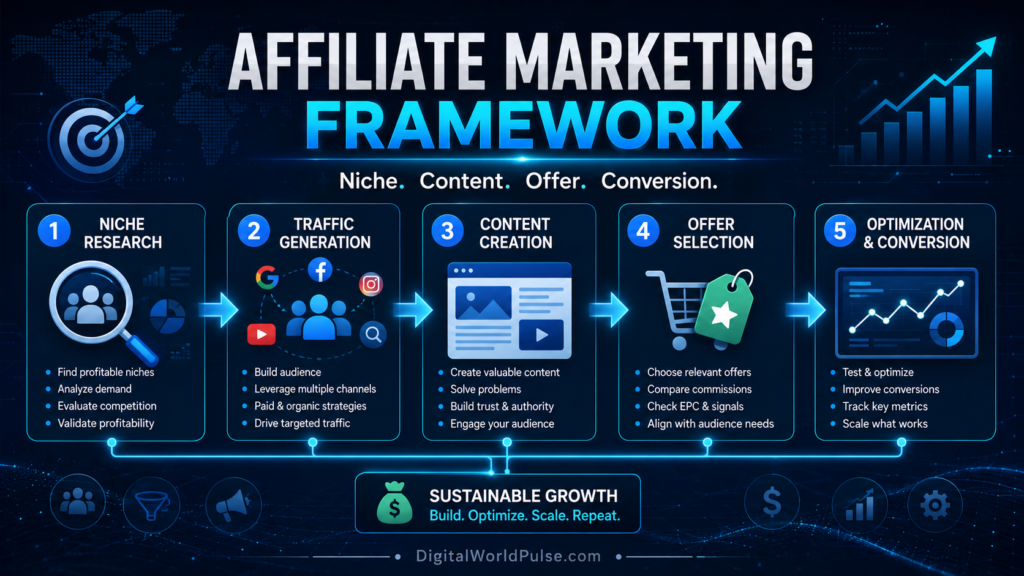
Affiliate marketing works best when useful content, relevant offers, trustworthy recommendations, and measurable conversion paths are planned together. A strong Affiliate Marketing Strategy should help the reader before it asks for a click, while giving the publisher a clear way to evaluate which topics, offers, and traffic sources actually produce meaningful results.
The goal is not to fill articles with commercial links. A practical Affiliate Marketing Strategy connects audience intent, offer selection, content quality, disclosure, tracking, and optimization into one repeatable system that can improve over time.
What Is an Affiliate Marketing Strategy?
An Affiliate Marketing Strategy is a structured plan for attracting a specific audience and connecting that audience with relevant products or services offered by another company.
When a visitor follows an affiliate link and completes a qualifying action, the publisher may receive a commission. Depending on the program, that action may include:
- a purchase;
- a free trial;
- a registration;
- a subscription;
- an application;
- a qualified lead.
A useful Affiliate Marketing Strategy should answer six questions:
- Who is the target audience?
- What problem are they trying to solve?
- Which offers are genuinely relevant?
- Which content should attract and educate them?
- Where will qualified traffic come from?
- How will clicks, conversions, and revenue be measured?
Without those answers, affiliate marketing becomes a collection of disconnected promotions rather than a system.
Start With Audience and Niche Research
A large commission does not matter if the offer is shown to the wrong audience.
The Affiliate Marketing Strategy should begin by defining a niche where three things overlap:
Audience need + content opportunity + commercial relevance
For example, an AI productivity website could naturally cover:
- automation tools;
- business planning;
- research software;
- email platforms;
- content creation;
- project management;
- marketing software.
Each subject creates opportunities for useful educational content before any recommendation is made.
A practical audience brief might include:
| Field | What to Define |
|---|---|
| Audience | Who are you trying to reach? |
| Main Problem | What are they trying to solve? |
| Intent | Informational, commercial, or transactional? |
| Current Solution | What do they already use? |
| Decision Factors | Price, features, ease of use, support? |
| Main Objection | What may stop them from acting? |
A strong Affiliate Marketing Strategy uses this research to determine what should be published, not just what can generate a commission.
For competitive research, the Competitor Analysis Template can help compare positioning, pricing, offers, and gaps in existing content.
Match Content to Buyer Intent
Not every visitor is ready to purchase.
Someone searching for:
What is email marketing?
is usually at a different stage from someone searching for:
Best email marketing software for small businesses
The first query is informational.
The second has stronger commercial intent.
A practical Affiliate Marketing Strategy can organize content around three broad intent levels.
Informational content
- tutorials;
- beginner guides;
- definitions;
- workflows;
- educational articles.
Commercial content
- comparisons;
- alternatives;
- reviews;
- “best tools” articles;
- feature breakdowns.
Transactional content
- pricing pages;
- trial-focused pages;
- discount pages;
- offer pages;
- signup-focused content.
These stages should connect naturally through internal links.
For example, an educational article can lead to a comparison page, and the comparison page can lead to a relevant offer.
This creates a more useful journey than placing the same affiliate CTA on every page.
Choose Affiliate Offers With a Scoring Framework
A strong Affiliate Marketing Strategy should evaluate offers before promoting them.
Do not choose a product only because the payout looks attractive.
Instead, score the offer against criteria such as:
- audience relevance;
- product quality;
- commission;
- conversion potential;
- cookie duration;
- geographic availability;
- landing-page quality;
- brand reputation;
- program restrictions;
- recurring revenue potential.
A simple scoring model can use a 1–5 scale.
| Factor | Weight | Score |
|---|---|---|
| Audience relevance | 30% | 5 |
| Product quality | 25% | 4 |
| Conversion potential | 20% | 4 |
| Commission economics | 15% | 3 |
| Program stability | 10% | 4 |
This prevents one large commission from dominating the decision.
An Affiliate Marketing Strategy should prioritize offers that make sense for the audience and the content, not simply the highest payout.
Understand CPA, CPS, CPL and EPC
Affiliate programs can reward different actions.
CPA — Cost Per Action
The publisher earns a commission after a defined action such as registration, trial activation, installation, or account creation.
CPS — Cost Per Sale
The commission is earned after a completed purchase.
CPL — Cost Per Lead
The program pays for a qualifying lead, such as a completed application or contact form.
Some programs also pay recurring commissions for subscription customers.
Another useful metric is:
EPC — Earnings Per Click
EPC helps compare how much revenue a campaign generates relative to affiliate clicks.
For example:
If 200 affiliate clicks generate $120 in commissions:
$120 ÷ 200 = $0.60 EPC
This does not tell the whole story, but it helps compare offers and pages more objectively.
A data-driven Affiliate Marketing Strategy looks at both payout and actual performance.
Create Affiliate Content With Original Value
Affiliate content should help readers make a decision.
The affiliate link should support the page rather than become the page.
Useful formats include:
- hands-on tutorials;
- product comparisons;
- buying guides;
- alternatives;
- workflows;
- case examples;
- decision checklists;
- feature comparisons;
- troubleshooting guides.
Google’s current spam policies describe “thin affiliation” as affiliate content that largely reproduces merchant material without meaningful original value. Google also gives examples of stronger affiliate pages that add information such as original reviews, testing, ratings, pricing information, navigation, or product comparisons.
That means a useful Affiliate Marketing Strategy should ask:
- What can this page explain that the merchant page does not?
- What comparison helps the reader?
- What limitation should be mentioned?
- What evidence supports the recommendation?
- Who is the product not suitable for?
The goal is to create a page worth visiting even if the affiliate link did not exist.
Build Content Clusters Instead of Isolated Articles
One affiliate article rarely creates a complete customer journey.
A stronger Affiliate Marketing Strategy connects related pages around one problem or product category so readers can move from education to comparison and then to a relevant offer.
For example, a marketing-software cluster could include:
- beginner guide;
- feature comparison;
- alternatives article;
- pricing explanation;
- setup tutorial;
- workflow guide;
- troubleshooting article;
- product comparison.
This structure lets each page serve a different search intent without forcing every article to become a sales page.
Internal links should also describe where the reader is going. For example, someone researching content creation could continue to the SEO Blog Writer Prompt, while someone planning publishing activity could use the Social Media Calendar.
A useful Affiliate Marketing Strategy treats internal linking as part of the reader journey, not simply an SEO requirement.
Create a Clear Conversion Path
Traffic has little commercial value if visitors do not understand what to do next.
An Affiliate Marketing Strategy should therefore map the steps between discovery and conversion.
One path might be:
Google Search → Tutorial → Comparison → Affiliate Offer
Another could be:
Social Media → Free Resource → Email Signup → Educational Sequence → Affiliate Offer
For each stage, define:
| Stage | Main Question |
|---|---|
| Discovery | Where does the visitor come from? |
| Content | What problem are they researching? |
| Evaluation | What alternatives should they compare? |
| CTA | What is the logical next action? |
| Offer | Which product matches the need? |
| Measurement | What conversion should be tracked? |
The offer should feel like a logical continuation of the content.
If the conversion path uses a dedicated page, the Landing Page Copywriter can help structure the headline, benefits, proof, objections, and CTA.
Use Multiple Traffic Sources Without Losing Focus
Depending on one platform creates unnecessary risk.
A resilient Affiliate Marketing Strategy can combine several acquisition channels while still measuring each one separately.
Useful channels may include:
- organic search;
- email;
- YouTube;
- social media;
- relevant online communities;
- partnerships;
- referral traffic;
- paid advertising where program rules allow it.
The objective is not to use every channel.
Choose the channels that fit the audience and the content format.
For example, software tutorials may work well through search and video, while a specialized B2B service may perform better through search, email, and direct partnerships.
A strong Affiliate Marketing Strategy should record the traffic source alongside clicks and conversions so high-volume traffic is not confused with high-quality traffic.
Build an Email Funnel That Adds Value First
Many visitors will not act during their first session.
Email can extend the relationship when people voluntarily subscribe.
A simple funnel could be:
Useful Article → Free Resource → Email Signup → Helpful Emails → Relevant Recommendation
The free resource should solve a real problem.
The emails should continue that value rather than immediately becoming a sequence of promotions.
For example, a subscriber downloading a workflow template might receive:
- setup guidance;
- a practical example;
- common mistakes;
- a comparison of available tools;
- a relevant recommendation.
The Email Marketing Campaign can help structure this follow-up process.
This makes the Affiliate Marketing Strategy less dependent on a single visit or search ranking.
Track the Metrics That Connect Traffic to Revenue
Affiliate optimization requires more than counting pageviews.
A practical Affiliate Marketing Strategy should monitor metrics such as:
- affiliate clicks;
- click-through rate;
- conversions;
- conversion rate;
- earnings per click;
- revenue per visitor;
- performance by page;
- performance by offer;
- performance by traffic source.
Consider two pages:
Page A: 10,000 visits, 300 affiliate clicks, 3 conversions.
Page B: 2,000 visits, 220 affiliate clicks, 18 conversions.
Page A attracts much more traffic, but Page B may be significantly more valuable commercially.
This is why traffic volume should not be evaluated separately from intent and conversion behavior.
Use a Simple Affiliate Performance Table
An Affiliate Marketing Strategy becomes easier to improve when performance is recorded consistently.
| Page | Clicks | Conversions | Revenue | Action |
|---|---|---|---|---|
| Tool comparison | 240 | 18 | $540 | Expand |
| Beginner guide | 130 | 4 | $120 | Improve CTA |
| Alternatives page | 190 | 12 | $360 | Test offer |
The exact numbers will vary by program.
The purpose of the table is to identify where additional testing is justified.
Test One Meaningful Variable at a Time
Once tracking works, optimization should become systematic.
A practical Affiliate Marketing Strategy can test:
- CTA wording;
- CTA placement;
- comparison format;
- offer selection;
- page introduction;
- product order;
- email subject lines;
- traffic source;
- landing-page message.
Changing several important variables simultaneously makes the result difficult to interpret.
Use a simple test record:
Hypothesis: A comparison CTA will generate more qualified clicks.
Version A: View Product
Version B: Compare Features and Pricing
Primary Metric: Affiliate click-through rate
Secondary Metric: Conversion rate
This keeps optimization connected to evidence rather than preference.
Disclose Affiliate Relationships Clearly
Transparency should be built into the Affiliate Marketing Strategy, not added as an afterthought.
The U.S. Federal Trade Commission explains that material connections between endorsers and companies should be clearly disclosed when they could affect how consumers evaluate a recommendation. See the official FTC endorsement guidance.
A disclosure should be noticeable and understandable.
It should not be hidden behind vague language or placed where readers are unlikely to see it.
The disclosure already used by Digital World Pulse at the beginning of affiliate articles serves this purpose without interrupting the rest of the content.
Qualify Commercial Links Correctly
Google recommends marking paid links, including affiliate links, with rel="sponsored".
The official guidance is available in Google’s link qualification documentation.
This helps search engines understand the commercial relationship behind the link.
Normal editorial internal links do not need the sponsored attribute.
A responsible Affiliate Marketing Strategy combines clear disclosure for readers with correct link qualification for search engines.

Use AI to Improve Research and Testing
AI can speed up repetitive work inside an Affiliate Marketing Strategy, especially when the inputs are specific.
It can help with:
- niche research;
- audience questions;
- content-gap analysis;
- comparison outlines;
- testing hypotheses;
- offer-scoring frameworks;
- campaign summaries;
- performance-review checklists.
However, AI should not invent:
- personal product experience;
- commission rates;
- conversion statistics;
- customer reviews;
- affiliate-program terms;
- pricing;
- financial results.
A reliable Affiliate Marketing Strategy separates verified facts from assumptions before anything is published.
If a recommendation depends on a product feature, price, payout, or restriction, verify that information directly before using it.
The AI Research Assistant can help organize supporting sources before they are added to commercial content.
Use the Affiliate Marketing Strategy Master Prompt
Role:
Act as an Affiliate Marketing Strategy planner.

Audience:
[DESCRIBE THE TARGET AUDIENCE]

Niche:
[DEFINE THE TOPIC OR MARKET]

Main Problems:
[LIST THE AUDIENCE'S MOST IMPORTANT PROBLEMS]

Content Assets:
[EXISTING ARTICLES / EMAIL LIST / SOCIAL CHANNELS / VIDEO / NONE]

Affiliate Offers:
[LIST VERIFIED PRODUCTS OR PROGRAMS]

Traffic Sources:
[SEO / EMAIL / SOCIAL / VIDEO / COMMUNITIES / PAID]

Primary Goal:
[CLICKS / LEADS / SALES / TRIALS / SUBSCRIPTIONS]

Known Data:
[TRAFFIC / CTR / EPC / CONVERSIONS / REVENUE]

Rules:
- Do not invent product experience, reviews, commissions, prices, or program terms.
- Label assumptions clearly.
- Prioritize audience relevance over payout.
- Include disclosure and sponsored-link requirements.
- Do not recommend misleading scarcity or unsupported claims.

Create:
1. Audience and intent summary
2. Content cluster
3. Offer scoring framework
4. Conversion path
5. Traffic plan
6. Email funnel
7. KPI dashboard
8. Three testing hypotheses
9. 30-day execution plan
10. Risks and information requiring verification
This Affiliate Marketing Strategy prompt is designed to create a working plan rather than generic promotional ideas.
Build a 30-Day Execution Plan
A first month should focus on building a measurable foundation.
Week 1 — Research
Define the audience, identify buyer problems, review competing content, and evaluate potential offers.
Week 2 — Build
Create foundational pages, commercial-intent content, internal links, disclosures, and conversion tracking.
Week 3 — Distribute
Promote useful content through the traffic channels most relevant to the audience.
Week 4 — Optimize
Review clicks, conversions, EPC, revenue per visitor, and traffic-source performance. Improve pages with potential and reconsider offers that attract clicks without producing useful results.
A practical Affiliate Marketing Strategy should treat this 30-day period as the start of a testing cycle, not a promise of immediate revenue.
Run a Final Affiliate Campaign Review
Before scaling a campaign, check:
- Is the audience clearly defined?
- Does the offer solve a relevant problem?
- Is the content useful without the affiliate link?
- Are important product claims verified?
- Is the affiliate relationship disclosed clearly?
- Are commercial links qualified correctly?
- Does the conversion path make sense?
- Are clicks and conversions tracked?
- Is the recommendation balanced?
- Are weak pages being improved instead of duplicated?
- Is each test connected to a measurable metric?
A strong Affiliate Marketing Strategy should make it easy to explain why a page exists, why an offer was selected, and what evidence supports the next optimization decision.
Avoid Common Affiliate Marketing Mistakes
Several mistakes can weaken performance and trust.
Avoid:
- promoting irrelevant products for higher commissions;
- copying merchant descriptions;
- hiding disclosures;
- publishing unverified claims;
- creating dozens of thin comparison pages;
- relying on one traffic source;
- tracking clicks without conversions;
- changing several test variables at once;
- recommending products without explaining limitations.
A sustainable Affiliate Marketing Strategy should improve usefulness and measurement at the same time.
Access the Complete Affiliate Marketing Strategy Guide
The downloadable Affiliate Marketing Strategy PDF is an optional companion to the complete framework provided in this article.
The page already includes audience research, buyer intent, offer scoring, CPA/CPS/CPL models, EPC, content clusters, conversion paths, traffic diversification, email funnels, tracking, testing, disclosure, link qualification, the Master Prompt, and a 30-day execution plan.
The PDF adds reusable worksheets, expanded planning templates, offer-evaluation sheets, performance tracking tools, and repeatable campaign-review resources.
Help Us Create More Free Resources
Digital World Pulse creates practical guides, useful tools, and downloadable resources that are freely available to everyone. Every resource requires time, research, hosting, design, testing, and software.


If you found this Affiliate Marketing Strategy useful, you can support our work through PayPal or Revolut. Your contribution is completely optional, and any amount—even the price of a coffee —helps us remain independent and continue creating useful resources.
Thank you for supporting Digital World Pulse and helping us continue this journey!
Our AI and technology content is developed through hands-on testing, official documentation review, product research, software evaluation, and workflow verification where applicable.
Where applicable, prompts, workflows, software features, and processes are tested directly before publication to verify how they work in real-world use.
Yes. AI tools and software platforms can change quickly, including interfaces, features, model capabilities, usage limits, and pricing.
Yes. AI-generated output can be incomplete, inconsistent, or inaccurate, so important results should be reviewed and verified by a human.
Articles may be updated when important changes occur to tools, interfaces, pricing, model capabilities, software behavior, or workflows.