
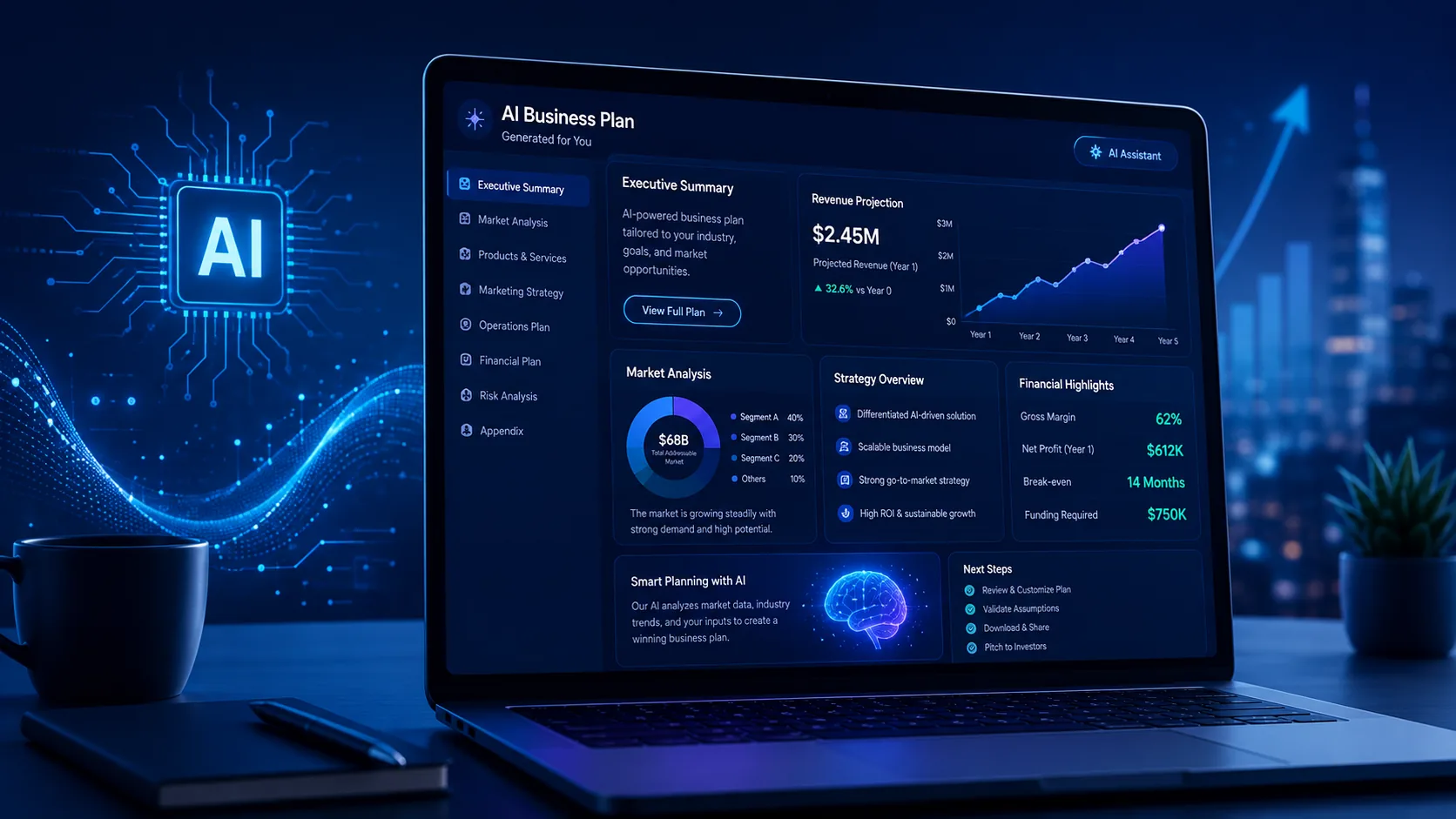
A business plan becomes useful when it connects a real customer problem with a clear offer, realistic market assumptions, a workable revenue model, and measurable next steps. The AI Business Plan Generator helps organize those moving parts into one structured planning process instead of producing a generic document from a one-line prompt.
The goal is not to let AI invent market numbers or predict whether a company will succeed. A practical AI Business Plan Generator should help you define assumptions, identify missing information, organize verified research, compare scenarios, and turn a business idea into a plan that can be reviewed and improved as new evidence appears.
What Is an AI Business Plan Generator?
An AI Business Plan Generator is a structured workflow that uses artificial intelligence to help organize the information required for a business plan.
A weak request might be:
Write a business plan for my startup.
That gives the AI almost no reliable context.
It does not explain:
- who the customer is;
- which problem is being solved;
- what the business sells;
- how pricing works;
- which alternatives already exist;
- how customers will be acquired;
- what the expected costs are;
- which assumptions still need verification.
A stronger AI Business Plan Generator begins with structured inputs before generating conclusions.
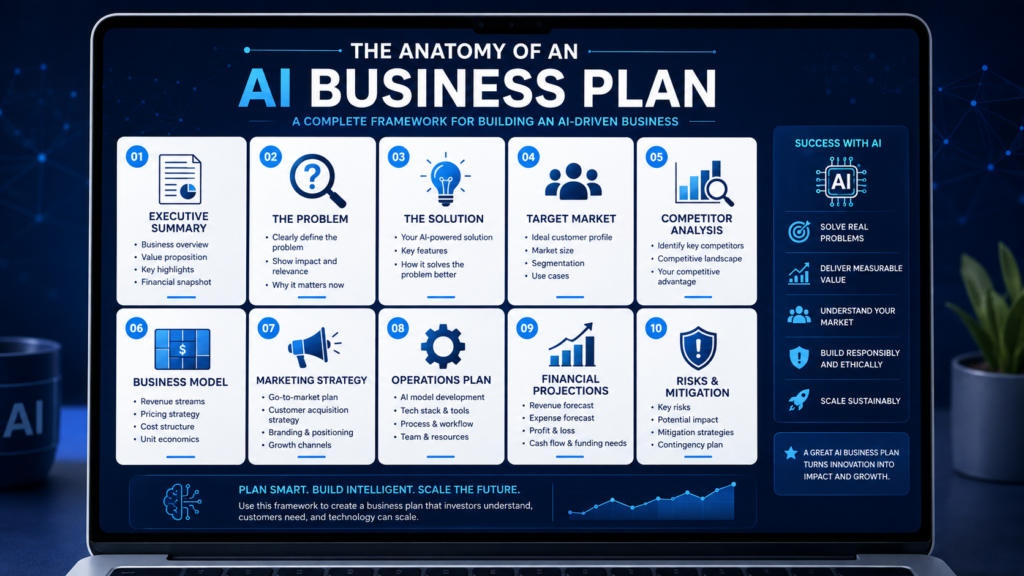
The core inputs should include:
| Area | What to Define |
|---|---|
| Business Idea | What is being built or sold? |
| Customer | Who has the problem? |
| Problem | What specific need exists? |
| Offer | What does the customer receive? |
| Market | How large and reachable is the opportunity? |
| Competitors | What alternatives already exist? |
| Revenue Model | How will the business make money? |
| Acquisition | How will customers discover the offer? |
| Costs | What must be paid to operate? |
| Risks | Which assumptions could fail? |
| Metrics | How will progress be measured? |
The value comes from making the reasoning visible.
AI can then help organize, compare, summarize, calculate, or rewrite the information without pretending that unknown facts are already known.
Start With the Customer Problem
A useful business plan should begin with a problem that can be described clearly.
Founders often start with the product because that is what they are building.
Customers usually start with their situation.
Imagine a company creating software for independent fitness coaches.
A vague description might say:
An AI-powered management platform for fitness professionals.
That explains the product category, but not the need.
A stronger problem statement would be:
Independent fitness coaches often manage appointments, payments, workout plans, progress updates, and client communication across several disconnected tools.
Now the AI Business Plan Generator has a concrete problem to investigate.
From there, useful questions include:
- Who experiences this problem most often?
- How are they solving it today?
- How much time or money does the current approach cost?
- What outcome would make switching worthwhile?
- Which part of the problem is most urgent?
- What evidence supports these assumptions?
The AI Research Assistant can support this stage by organizing sources and separating verified information from assumptions.
Define the Initial Customer Segment
Trying to serve everyone usually produces an unclear business plan.
The AI Business Plan Generator should begin with a narrow initial customer profile and expand only when evidence supports it.
For a B2B company, useful inputs might include:
- industry;
- company size;
- job role;
- purchasing authority;
- current tools;
- budget range;
- buying trigger;
- main objection.
For a consumer business, useful inputs may include:
- location;
- lifestyle;
- purchase behavior;
- frequency of need;
- current alternatives;
- price sensitivity.
For example:
Customer: Independent fitness coaches with 20–100 active clients
Problem: Client administration is spread across multiple tools
Current Alternative: Spreadsheets, messaging apps, calendar software, payment tools
Desired Outcome: Manage client work from one place
Main Objection: Switching systems may take too much time
This level of specificity gives the AI Business Plan Generator something useful to work with.
Estimate Market Size With Explainable Assumptions
Market size should not be a large number copied into a plan without context.
A practical framework uses:
TAM — Total Addressable Market
The broadest potential demand relevant to the offer.
SAM — Serviceable Available Market
The part of that market the business can actually serve based on product, geography, pricing, or distribution.
SOM — Serviceable Obtainable Market
The portion the company could realistically attempt to reach during a defined period.
The calculation should be explainable.
For example:
8,000 potential businesses × $1,200 estimated annual revenue per customer = $9.6 million theoretical annual opportunity for the defined segment.
That does not mean the business will capture $9.6 million.
It simply shows how the assumption was built.
A reliable AI Business Plan Generator should label figures as either:
- verified data;
- calculated estimates;
- founder assumptions;
- scenarios requiring validation.
This distinction matters because AI-generated confidence should never replace evidence.
Analyze Competitors as Customer Alternatives
Competitor analysis is not about creating a table where your business appears better in every category.
It should explain what customers can choose instead.
For a new software product, alternatives may include:
- direct software competitors;
- spreadsheets;
- manual processes;
- agencies;
- freelancers;
- internal tools;
- doing nothing.
A practical AI Business Plan Generator can compare competitors using criteria such as:
- target customer;
- pricing;
- core offer;
- positioning;
- important features;
- distribution;
- strengths;
- limitations;
- customer complaints;
- possible gaps.
For deeper competitor research, use the Competitor Analysis Template to build a more detailed comparison.
The purpose is to identify where the business may fit, which assumptions need testing, and why a customer might choose one option over another.
Build a Business Model That Connects Value and Revenue
A business plan needs to explain how the company creates value and how that value becomes revenue.
The AI Business Plan Generator should connect four elements:
Customer → Offer → Pricing → Cost Structure
A business may use:
- subscriptions;
- one-time purchases;
- service retainers;
- usage-based pricing;
- licensing;
- commissions;
- memberships;
- a hybrid model.
The important point is that pricing should not exist in isolation.
For example:
Offer: Project-management software for small agencies
Price: $49 per month
Customer: Agencies managing multiple client projects
Value: Less time spent chasing updates
Delivery Cost: Hosting, support, software tools, payment processing
A useful AI Business Plan Generator should then ask:
- How many paying customers are assumed?
- How quickly can they be acquired?
- Which costs increase with each customer?
- Which costs remain mostly fixed?
- What level of churn is realistic?
- How many customers are needed to cover operating costs?
The purpose is not to create false precision.
The purpose is to make every major financial assumption visible.
Turn the Offer Into Something Customers Can Understand
A business model can look good in a spreadsheet and still fail if the offer is unclear.
The plan should explain:
- what the customer receives;
- what problem it solves;
- what outcome it supports;
- what makes it different from alternatives;
- what the customer is expected to pay.
Compare:
AI-powered marketing solution
with:
A monthly content-planning service for local businesses that includes keyword research, a 30-day content calendar, draft social posts, and a performance review.
The second version is much easier to evaluate.
The AI Business Plan Generator can help turn broad ideas into a clear offer statement.
A useful structure is:
For [customer], we provide [offer] that helps achieve [outcome] by [method], unlike [main alternative].
For product-focused businesses, the Product Description Expert can help translate features into clearer customer benefits.
Create a Practical Go-to-Market Strategy
A business plan should explain how customers are expected to discover, evaluate, and buy the offer.
The AI Business Plan Generator should not simply list every possible marketing channel.
It should connect the customer profile to the most realistic acquisition channels.
Possible channels include:
- organic search;
- paid advertising;
- direct outreach;
- partnerships;
- email marketing;
- social media;
- marketplaces;
- referrals;
- affiliate relationships;
- communities;
- events.
A practical acquisition plan might look like this:
| Stage | Question | Example |
|---|---|---|
| Reach | Where is the customer? | Google Search |
| Message | What problem matters? | Reduce admin time |
| Offer | What is presented? | 14-day trial |
| Conversion | What action is required? | Create account |
| Follow-up | What happens next? | Onboarding email |
| Metric | What is measured? | Trial-to-paid rate |
This gives the AI Business Plan Generator a much stronger foundation than a generic statement such as “use social media and SEO.”
For execution support, the Email Marketing Campaign and Social Media Calendar can help build the next layer of the plan.
Plan the Conversion Path
Traffic alone does not create customers.
A strong AI Business Plan Generator should map the full conversion path.
Examples:
Paid Ad → Landing Page → Demo → Sales Call → Customer
Search → Article → Email Signup → Offer → Purchase
Social Media → Product Page → Checkout → Customer
Each step creates possible friction.
The business plan should identify:
- where prospects first discover the company;
- what message they see;
- what action they take;
- what happens after that action;
- where prospects may drop out;
- what metric shows whether the step works.
If the business depends on a dedicated conversion page, the Landing Page Copywriter provides a complementary framework for headlines, proof, objections, offers, and CTAs.
Build Financial Projections From Assumptions
Financial projections are useful when they show how the business works.
The AI Business Plan Generator should start with the inputs rather than asking AI to invent a polished five-year forecast.
A basic model may begin with:
Customers × Average Revenue per Customer = Revenue
Example:
100 customers × $50 per month = $5,000 monthly revenue
Then add operating costs.
Suppose monthly expenses are:
- software infrastructure: $800;
- marketing: $1,200;
- contractor support: $1,000;
- administration: $500;
- payment and transaction costs: $250.
Total estimated monthly operating cost:
$3,750
That leaves:
$5,000 revenue − $3,750 costs = $1,250 before taxes and other unmodeled expenses
The exact figures are less important than the logic behind them.
A useful AI Business Plan Generator should separate:
- revenue assumptions;
- fixed costs;
- variable costs;
- customer acquisition costs;
- payroll;
- infrastructure;
- taxes and fees where relevant;
- funding requirements.
Use Scenarios Instead of One Perfect Forecast
One forecast can create a false sense of certainty.
The AI Business Plan Generator becomes more useful when it compares several scenarios.
For example:
Conservative Scenario
- slower customer acquisition;
- higher marketing costs;
- lower conversion;
- higher churn.
Baseline Scenario
- the assumptions currently considered most realistic.
Upside Scenario
- faster adoption;
- stronger retention;
- better conversion;
- lower acquisition cost.
A simple comparison might be:
| Scenario | Customers | Monthly Revenue | Monthly Costs |
|---|---|---|---|
| Conservative | 60 | $3,000 | $3,800 |
| Baseline | 100 | $5,000 | $4,200 |
| Upside | 150 | $7,500 | $5,100 |
This is not a prediction.
It is a planning model.
The AI Business Plan Generator should help identify which assumptions change the outcome most.
Useful questions include:
- What happens if revenue is 30% lower?
- What happens if acquisition costs double?
- How long does available cash last?
- Which expenses can be delayed?
- At what point is additional funding required?
- Which metric would trigger a change in strategy?
Identify Business Risks Before Launch
Every plan contains uncertainty.
A strong AI Business Plan Generator should make those risks visible.
Common categories include:
- market risk;
- competition;
- financial risk;
- operational risk;
- technology risk;
- regulatory risk;
- supplier dependency;
- customer concentration;
- hiring challenges;
- pricing assumptions.
A practical risk table can use four fields:
| Risk | Probability | Impact | Response |
|---|---|---|---|
| Acquisition cost rises | Medium | High | Test alternative channels |
| Customer churn exceeds target | Medium | High | Improve onboarding |
| Supplier delay | Low | Medium | Add backup supplier |
This turns risk analysis into a decision tool.
The AI Business Plan Generator should not remove uncertainty from the plan.
It should make uncertainty easier to manage.
Define the Metrics That Test the Plan
A business plan becomes stronger when it includes measurable indicators.
Depending on the model, useful metrics may include:
- customer acquisition cost;
- monthly recurring revenue;
- conversion rate;
- average order value;
- gross margin;
- customer retention;
- churn;
- sales pipeline;
- cash runway;
- break-even progress;
- website leads;
- repeat purchases.
The AI Business Plan Generator should connect each metric to a major assumption.
For example:
If the plan assumes low churn, monitor retention.
If the plan assumes paid ads can acquire customers efficiently, monitor acquisition cost.
If the plan depends on repeat purchases, measure repeat purchase rate.
This keeps the plan connected to real performance rather than leaving it as a static document.
Use AI to Structure the Plan, Not Invent Evidence
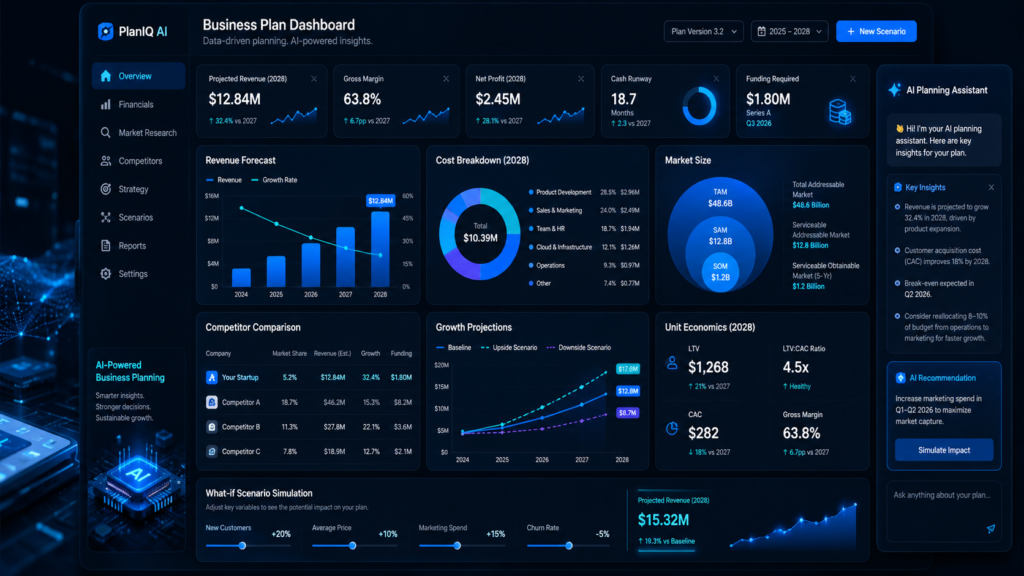
AI can help organize research, compare alternatives, summarize findings, model scenarios, and improve clarity. But an AI Business Plan Generator should never fabricate market size, customer interviews, revenue, competitor data, testimonials, or financial results.
A practical rule is:
Verified fact → cite the source
Calculated estimate → show the formula
Founder assumption → label it clearly
Unknown information → list it for validation
This makes the plan easier to review and update.
A strong AI Business Plan Generator should also separate what is known from what is still being tested. That is especially important for pricing, market demand, acquisition cost, churn, and growth assumptions.
Use the AI Business Plan Generator Master Prompt
Role:
Act as an AI Business Plan Generator and strategic planning assistant.

Business:
[DESCRIBE THE BUSINESS IDEA]

Target Customer:
[DEFINE THE INITIAL CUSTOMER SEGMENT]

Problem:
[WHAT PROBLEM IS BEING SOLVED?]

Offer:
[WHAT PRODUCT OR SERVICE IS BEING SOLD?]

Pricing:
[CURRENT OR PROPOSED PRICING]

Market:
[GEOGRAPHY / INDUSTRY / CUSTOMER TYPE]

Competitors:
[LIST VERIFIED COMPETITORS OR ALTERNATIVES]

Acquisition Channels:
[SEARCH / ADS / EMAIL / OUTREACH / PARTNERSHIPS / OTHER]

Financial Assumptions:
[REVENUE, COSTS, CUSTOMER GROWTH, FUNDING]

Known Risks:
[LIST IMPORTANT RISKS]

Rules:
- Do not invent market statistics, customer research, revenue, or competitor facts.
- Label assumptions clearly.
- Flag information that requires verification.
- Separate verified evidence from estimates.
- Show formulas used for important calculations.
- Do not present forecasts as guaranteed outcomes.

Create:
1. Executive summary
2. Customer problem
3. Target market
4. Competitor analysis
5. Offer and positioning
6. Revenue model
7. Go-to-market strategy
8. Conversion path
9. Operations plan
10. Financial assumptions
11. Conservative, baseline, and upside scenarios
12. Risk analysis
13. KPIs
14. 90-day action plan
15. Questions that still require validation
The AI Business Plan Generator prompt is designed to produce a working plan, not a polished document filled with unsupported certainty.
Run a Final Business Plan Review
Before using the plan for decisions, check:
- Is the customer clearly defined?
- Is the problem supported by evidence?
- Is the offer specific?
- Are market estimates explainable?
- Are competitors based on real research?
- Is pricing connected to customer value and costs?
- Are financial assumptions visible?
- Are forecasts presented as scenarios rather than certainty?
- Are major risks identified?
- Are KPIs connected to the assumptions that matter?
- Does the plan explain what should be tested next?
An AI Business Plan Generator becomes most useful when the document can change with the business.
Access the Complete AI Business Plan Generator
The downloadable AI Business Plan Generator PDF is an optional working companion to the complete process explained above.
The article already provides the core framework directly on the page, including customer definition, market sizing, competitor analysis, business-model planning, go-to-market strategy, financial assumptions, scenario analysis, risks, KPIs, and the reusable Master Prompt.
The PDF adds reusable worksheets, expanded planning templates, financial-assumption tools, scenario exercises, and review pages for future business ideas.
Help Us Create More Free Resources
Digital World Pulse creates practical guides, useful tools, and downloadable resources that are freely available to everyone. Every resource requires time, research, hosting, design, testing, and software.


If you found the AI Business Plan Generator helpful, you can support our work through PayPal or Revolut. Your contribution is completely optional, and any amount—even the price of a coffee —helps us remain independent and create more valuable resources.
Thank you for supporting Digital World Pulse and helping us continue this journey!
Our AI and technology content is developed through hands-on testing, official documentation review, product research, software evaluation, and workflow verification where applicable.
Where applicable, prompts, workflows, software features, and processes are tested directly before publication to verify how they work in real-world use.
Yes. AI tools and software platforms can change quickly, including interfaces, features, model capabilities, usage limits, and pricing.
Yes. AI-generated output can be incomplete, inconsistent, or inaccurate, so important results should be reviewed and verified by a human.
Articles may be updated when important changes occur to tools, interfaces, pricing, model capabilities, software behavior, or workflows.