
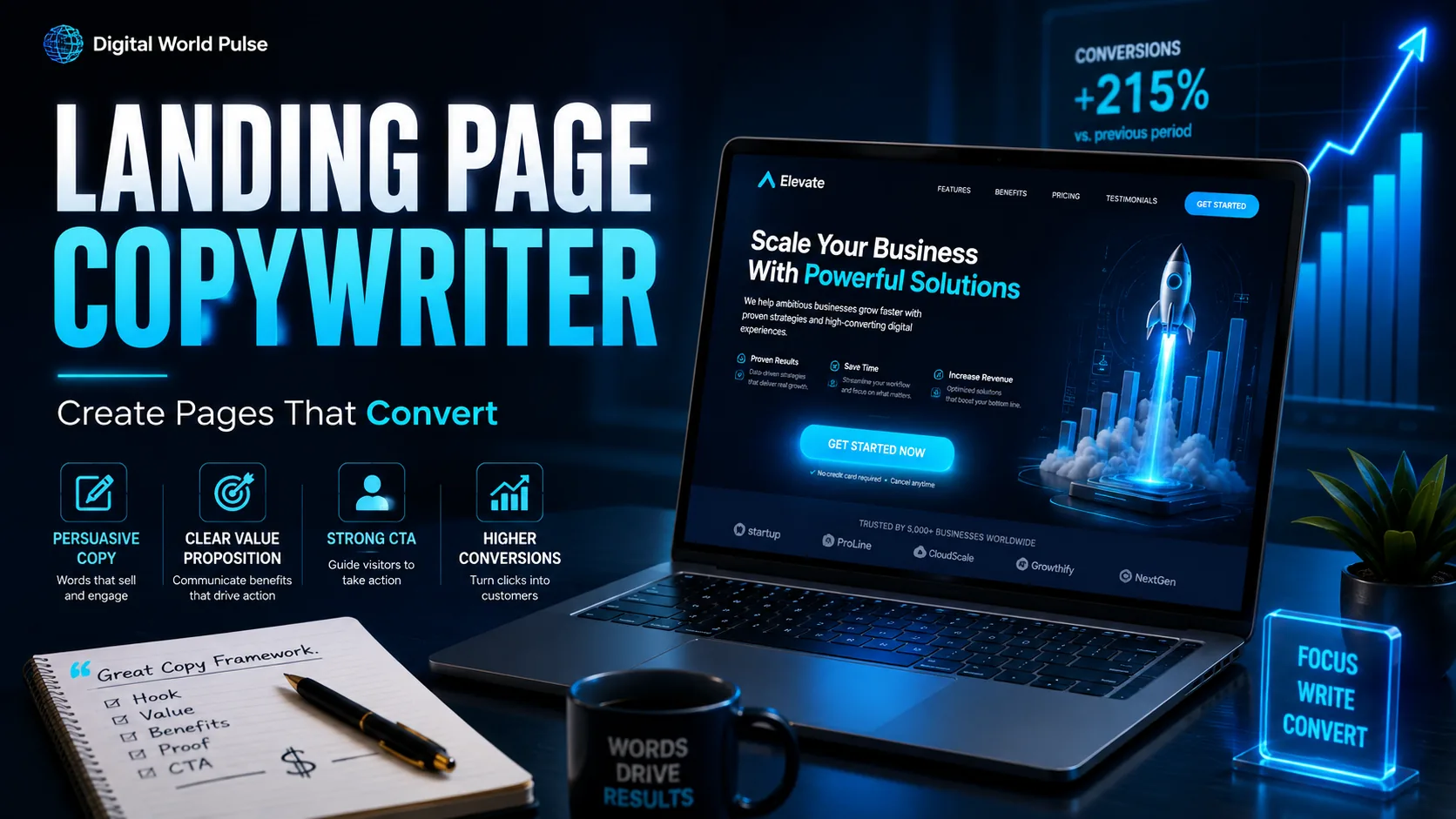
A landing page has one main job: move the right visitor toward one clear action.
Many pages fail because the copy is vague, overloaded, or focused too heavily on the business instead of the customer. A practical Landing Page Copywriter process helps solve that problem by connecting audience insight, offer clarity, proof, objections, and calls to action into one focused conversion flow.
The goal is not to make every sentence sound aggressive or “salesy.”
The goal is to help visitors quickly understand:
- what the offer is;
- who it is for;
- why it matters;
- what evidence supports it;
- what happens next.
This guide provides the core framework directly on the page so you can plan and write a complete landing page without depending on the downloadable PDF.
What Is a Landing Page Copywriter?
A Landing Page Copywriter is a structured system for planning and producing conversion-focused landing page copy.
Instead of asking AI to simply “write a landing page,” the process starts with the information that determines whether the message will be relevant.
That includes:
- target audience;
- traffic source;
- customer problem;
- desired outcome;
- core offer;
- objections;
- proof;
- primary CTA;
- level of awareness.
A useful landing page should answer the visitor’s main questions in a logical order.
For example:
What is this?
Clarify the offer.
Is it for me?
Identify the audience.
Why should I care?
Explain the practical outcome.
Why should I trust it?
Add proof.
What happens next?
Make the CTA clear.
A strong Landing Page Copywriter workflow organizes those answers before the final copy is written.
Define the Conversion Goal First
Before writing the headline, define exactly what action the page should encourage.
Possible goals include:
- start a free trial;
- request a demo;
- download a template;
- join a newsletter;
- book a consultation;
- purchase a product;
- register for an event;
- submit a lead form.
A landing page with several competing goals often creates unnecessary friction.
For example, if the primary goal is:
Start a free trial
then the page should not repeatedly interrupt the visitor with unrelated CTAs for newsletters, downloads, social profiles, and other offers.
The Landing Page Copywriter should keep one primary action visible throughout the page.
Build a Simple Landing Page Brief
Before drafting, complete a short conversion brief.
| Field | What to Define |
|---|---|
| Audience | Who is the page for? |
| Traffic Source | Search, ads, email, social, referral |
| Problem | What is the visitor trying to solve? |
| Desired Outcome | What result do they want? |
| Offer | What exactly are you providing? |
| Main Objection | What may stop them from acting? |
| Proof | What can you genuinely verify? |
| Primary CTA | What should happen next? |
For example:
Audience: Small agencies managing several client projects
Traffic Source: Google Ads
Problem: Too much time spent chasing project updates
Desired Outcome: Faster project visibility
Offer: 14-day software trial
Main Objection: Setup complexity
Proof: Product demonstration and verified customer feedback
CTA: Start My Free Trial
This gives the Landing Page Copywriter enough context to create specific copy instead of generic marketing language.
Match the Landing Page to the Traffic Source
Visitors arrive with an expectation created before they reach the page.
If an ad promises:
Track client projects without spreadsheets
the landing page should not suddenly lead with:
The complete operating system for modern teams
The second message may be broader, but it weakens continuity.
Strong landing page copy keeps the traffic source and landing page aligned.
For paid campaigns, Google Ads recommends making landing pages relevant to the ad and keywords that brought visitors there while providing useful information about the offer. Review the official Google Ads landing page guidance.
Write a Clear Hero Section
The first screen should explain the offer quickly.
A practical hero usually contains:
- headline;
- supporting sentence;
- primary CTA;
- relevant proof or reassurance;
- visual or product demonstration when useful.
Compare:
Weak headline
Advanced Project Management Solutions
Stronger headline
Plan Client Projects in One Place Without Chasing Updates Across Five Tools
The second version communicates a more specific problem and outcome.
A useful headline formula is:
Desired Outcome + Reduced Friction
For example:
Create Weekly Client Reports Without Rebuilding the Same Spreadsheet
Another option is:
Problem + Clear Solution
Stop Losing Project Updates Across Email, Chat, and Spreadsheets
Do not force formulas when they make the headline unnatural.
The best headline is the one that helps the right visitor understand the offer fastest.
Turn Features Into Customer Outcomes
Features explain what the offer contains.
Benefits explain why those features matter.
For example:
Feature: Automated weekly reports
Practical effect: Updates are generated automatically
Customer outcome: Less time spent rebuilding client reports
A simple framework is:
Feature → Practical Effect → Customer Outcome
Another example:
Feature: One-click import
Practical effect: Existing data moves quickly
Customer outcome: Faster setup with less migration work
The Landing Page Copywriter should make these connections explicit instead of assuming visitors will translate technical features into value themselves.
For product-focused offers, the Product Description Expert provides a separate framework for turning specifications into clearer customer benefits.
Use Proof to Reduce Uncertainty
Visitors rarely know as much about the offer as the business does.
That means the page has to support important claims with evidence instead of asking the visitor to simply trust the copy.
Useful proof can include:
- real customer testimonials;
- product demonstrations;
- screenshots;
- case examples;
- verified numbers;
- recognizable clients or partners;
- transparent policies;
- guarantees;
- clearly explained limitations.
The strength of the proof should match the strength of the claim.
If the page says a workflow is faster, show how it works.
If it says customers save time, explain how that result was measured.
If you use a testimonial, keep it accurate and attributable.
A responsible Landing Page Copywriter should never invent customer quotes, statistics, logos, results, or product capabilities just because they would make the page sound stronger.
For evidence-heavy pages, the AI Research Assistant can help organize and verify source material before it is turned into copy.
Handle Objections Before They Become Exit Points
Every offer creates some uncertainty.
The visitor may wonder:
- Is this too expensive?
- Is it difficult to use?
- Will it work for my situation?
- How long will setup take?
- Can I cancel?
- Do I need technical knowledge?
- What happens after I buy?
- Is my information secure?
Do not hide these questions.
Address the objections that actually matter.
Some belong near the CTA.
Others fit better in:
- pricing;
- FAQs;
- onboarding explanations;
- proof sections;
- guarantee language.
The Landing Page Copywriter should identify the most important friction points before drafting instead of adding a huge generic FAQ at the end.
Write Calls to Action That Explain the Next Step
A CTA should make the next action understandable.
Vague buttons such as:
Submit
Click Here
Continue
force the visitor to guess what happens next.
More useful CTA copy might be:
- Start My Free Trial
- View the Demo
- Download the Template
- Get the Checklist
- See Pricing
- Book a Consultation
The CTA should match the level of commitment required.
A low-friction resource may use a download.
A software page may use a trial.
A high-value service may require a consultation.
Nielsen Norman Group recommends descriptive link and CTA labels instead of vague wording. Their guidance is available in Get Started Stops Users.
If the landing page connects to an email sequence, the Email Marketing Campaign can help structure the next stage of the journey.
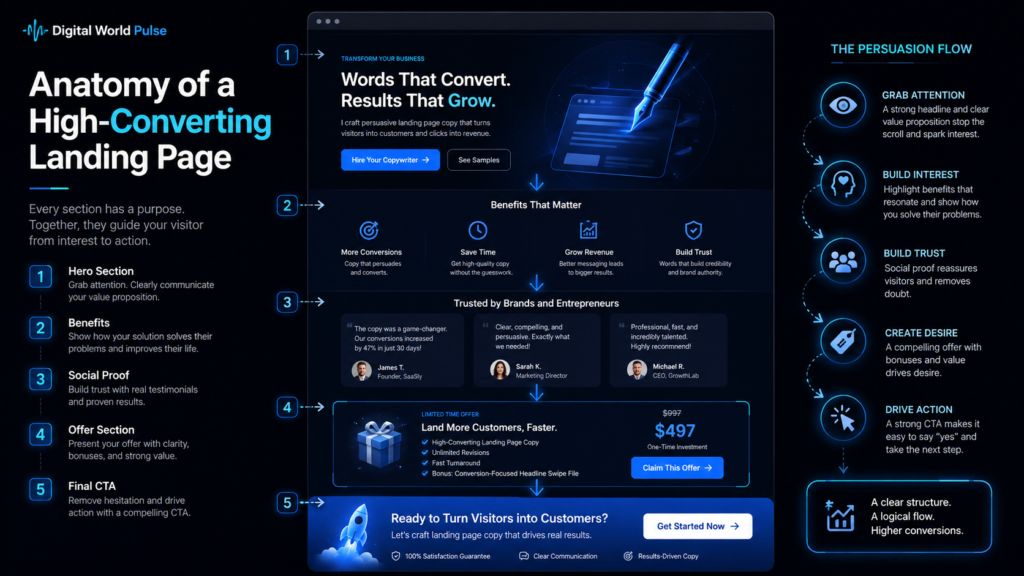
Build a Logical Landing Page Flow
A landing page should feel like one argument, not a pile of unrelated sections.
A practical sequence can be:
- Hero — clarify the main promise.
- Problem — show understanding of the visitor.
- Outcome — explain what improves.
- Benefits — connect features to real value.
- How It Works — reduce uncertainty.
- Proof — support important claims.
- Objections — answer concerns.
- Offer — explain what is included.
- CTA — make the next step clear.
- Reassurance — reduce final hesitation.
Not every page needs all ten sections.
A simple lead magnet may need only a few.
A higher-cost product or service may require more proof and explanation.
A strong Landing Page Copywriter should adapt the structure to the offer instead of forcing every page into the same template.
Use a Copy Framework Before Writing the Full Draft
A compact framework helps keep the page focused.
Use:
Audience → Problem → Promise → Proof → Objection → CTA
Example:
Audience: Small agencies
Problem: Project updates are scattered across several tools
Promise: Centralize project visibility
Proof: Product demonstration and verified customer feedback
Objection: Setup may feel complicated
CTA: Start My Free Trial
This keeps the copy grounded in the customer journey instead of filling the page with persuasive language that does not support a clear decision.
Use AI to Draft, Not to Invent
AI can speed up landing page work when the brief is strong.
It can help generate:
- headline variations;
- benefit rewrites;
- CTA options;
- objection ideas;
- section structures;
- shorter versions;
- tone variations;
- A/B test concepts;
- copy audits.
But AI should not invent:
- scarcity;
- guarantees;
- testimonials;
- customer results;
- statistics;
- product features;
- certifications;
- partnerships.
A safe Landing Page Copywriter workflow is:
Verified Input → Draft → Human Review → Claim Check → Publish → Test
For supporting search-focused content, the SEO Blog Writer Prompt provides a separate workflow for long-form articles.
Ready-to-Use Landing Page Copywriter Master Prompt
Role:
Act as a conversion-focused Landing Page Copywriter.

Audience:
[DESCRIBE THE TARGET VISITOR]

Traffic Source:
[SEARCH / ADS / EMAIL / SOCIAL / REFERRAL]

Primary Problem:
[WHAT IS THE VISITOR TRYING TO SOLVE?]

Desired Outcome:
[WHAT RESULT DO THEY WANT?]

Offer:
[DESCRIBE THE PRODUCT, SERVICE, OR RESOURCE]

Primary CTA:
[DEFINE ONE MAIN ACTION]

Proof Available:
[TESTIMONIALS / DEMO / CASE STUDY / VERIFIED DATA / GUARANTEE / NONE]

Main Objections:
[LIST THE MOST IMPORTANT CONCERNS]

Brand Voice:
[DEFINE 3–5 VOICE ATTRIBUTES]

Rules:
- Do not invent testimonials, statistics, scarcity, guarantees, results, or product capabilities.
- Use only verified claims.
- Keep the page focused on one primary conversion goal.
- Match the message to the traffic source.
- Prefer specific language over vague marketing phrases.
- Flag any claim that needs verification.

Task:
Create a landing page structure with:
1. Hero headline
2. Supporting copy
3. Primary CTA
4. Problem section
5. Benefits
6. How it works
7. Proof section
8. Objection handling
9. Offer summary
10. Final CTA

Then provide:
- 3 headline variations
- 3 CTA variations
- Claims requiring verification
- One A/B test hypothesis
This prompt gives the Landing Page Copywriter enough context to create a useful draft without giving the AI permission to invent evidence.
Review the Draft Before Publishing
Before approving the page, check:
- Is the audience obvious?
- Is the main offer clear?
- Does the hero match the traffic source?
- Are features connected to outcomes?
- Are claims supported?
- Is the main objection answered?
- Is there one clear primary CTA?
- Are testimonials real?
- Are links working?
- Is the page easy to scan on mobile?
The purpose of the review is not to make the copy longer.
It is to remove ambiguity and unsupported persuasion.
Test the Message Instead of Guessing
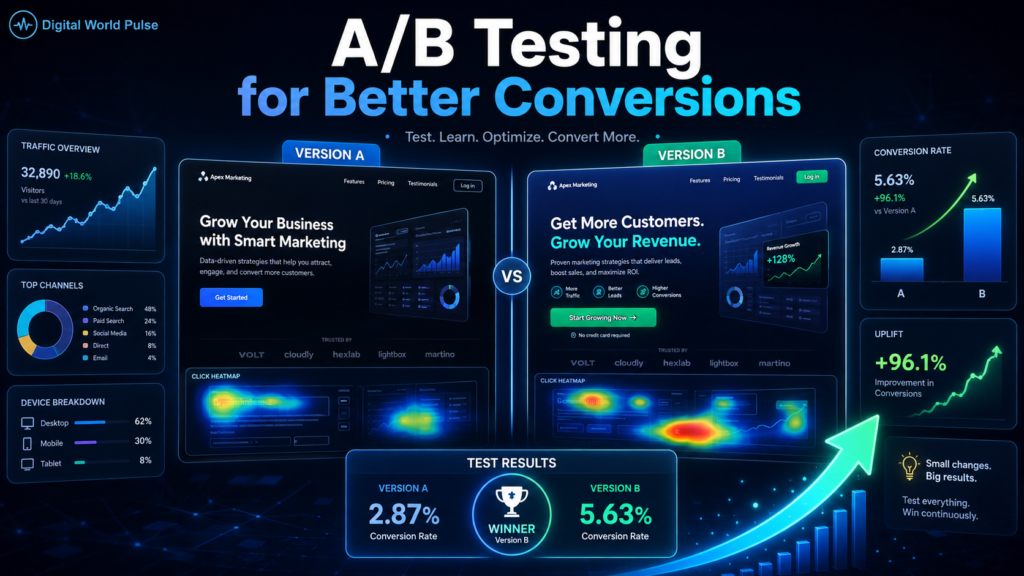
A landing page should improve through evidence, not endless opinion.
After publishing, choose one meaningful variable to test at a time.
Useful test areas include:
- headline;
- CTA wording;
- hero layout;
- offer framing;
- proof placement;
- pricing presentation;
- form length;
- guarantee language;
- benefit order;
- page length.
For example:
Hypothesis:
A more specific CTA will increase trial starts.
Version A:
Get Started
Version B:
Start My Free Trial
Primary Metric:
Completed trial signups
The Landing Page Copywriter should record the hypothesis, variation, metric, and result so future pages benefit from what was learned.
Measure the Right Conversion Signals
Not every landing page should be judged only by clicks.
The most useful metric depends on the conversion goal.
Possible signals include:
- completed purchases;
- trial starts;
- booked calls;
- qualified leads;
- downloads;
- registrations;
- form completions;
- CTA clicks;
- abandonment points.
A page can generate many clicks while producing poor-quality leads.
That is why the Landing Page Copywriter process should connect the CTA to the real business outcome.
Use a Simple Testing Log
A compact test record can look like this:
| Test | Change | Primary Metric | Result | Decision |
|---|---|---|---|---|
| Hero CTA | More specific wording | Trial starts | Improved | Keep |
| Headline | Outcome-focused message | Signup rate | No clear change | Retest |
| Form | Removed 2 fields | Completion rate | Improved | Keep |
The purpose is not to run dozens of experiments.
It is to learn which messages reduce friction for the right visitors.
Review the Complete Conversion Path
Landing page performance does not end at the button.
If the CTA sends visitors to:
- checkout;
- signup;
- booking;
- email confirmation;
- onboarding;
- download;
review that next step too.
A strong landing page can still underperform if the next page is confusing, slow, or inconsistent with the promise.
The Landing Page Copywriter should therefore check message continuity across the complete conversion path.
If the page leads into an email sequence, the Email Marketing Campaign can help organize that follow-up process.
Example: Improve a SaaS Landing Page
Suppose a small project-management platform wants more free-trial signups.
The original hero says:
Powerful Project Management for Modern Teams
The message is broad and does not explain the problem being solved.
A stronger version might be:
Keep Client Projects, Deadlines, and Updates in One Place
Supporting copy:
Give your team one workspace for tasks, progress updates, files, and client visibility without rebuilding the same project status every week.
CTA:
Start My Free Trial
Proof:
Product screenshots, verified customer feedback, and a short workflow demonstration.
Objection:
No credit card required. Import existing projects before deciding whether the workflow fits your team.
This example works because every section supports the same conversion goal instead of introducing unrelated messages.
Create a Final Landing Page Checklist
Before launch, review the page one last time.
Strategy
- Is there one primary conversion goal?
- Is the audience specific?
- Does the page match the traffic source?
- Is the offer easy to understand?
Copy
- Is the headline specific?
- Are benefits connected to real outcomes?
- Are unnecessary claims removed?
- Is the language easy to scan?
Proof
- Are testimonials genuine?
- Are statistics verified?
- Are product claims accurate?
- Is supporting evidence placed near important claims?
CTA
- Does the CTA explain what happens next?
- Is the primary CTA visually and verbally consistent?
- Are competing actions minimized?
Trust and Usability
- Are important limitations clear?
- Are links working?
- Is pricing accurate?
- Does the page work well on mobile?
- Is the next step after the CTA clear?
The Landing Page Copywriter should not mark the page as ready until these checks are complete.
Avoid Common Landing Page Copy Mistakes
Even strong offers can underperform when the message creates unnecessary friction.
Avoid:
- vague headlines;
- multiple unrelated CTAs;
- invented urgency;
- unsupported statistics;
- fake testimonials;
- excessive jargon;
- features without customer outcomes;
- long introductions before explaining the offer;
- hiding important conditions;
- copying competitor language without understanding the audience.
Good conversion copy is usually clearer, not louder.
Keep the Page Easy to Improve
Landing pages are not permanent documents.
Products change.
Pricing changes.
Traffic sources change.
Customer objections change.
New proof becomes available.
Record:
- current offer;
- traffic source;
- primary CTA;
- major claims;
- proof used;
- test history;
- conversion metric;
- last review date.
This makes the Landing Page Copywriter workflow easier to update without rewriting the entire page from zero.
Strengthen Every Landing Page Copywriter Workflow
A strong Landing Page Copywriter should connect audience research, offer clarity, proof, objections, CTA design, verification, and testing into one repeatable process.
Before publishing, confirm that the page gives the visitor clear answers to five questions:
What is this?
Is it for me?
Why should I care?
Why should I trust it?
What should I do next?
If those answers are clear, the page is already stronger than one built around generic persuasive language.
A strong Landing Page Copywriter keeps the message focused on one clear conversion goal.
A practical Landing Page Copywriter connects proof, benefits, objections, and CTA in one consistent flow.
A reliable Landing Page Copywriter helps improve clarity without adding unnecessary copy.
Access the Complete Landing Page Copywriter
The downloadable Landing Page Copywriter PDF is an optional companion to the full workflow explained above.
The article already provides the core tools directly on the page, including:
- landing page brief;
- traffic-message matching;
- hero framework;
- feature-to-benefit method;
- proof and objection handling;
- CTA structure;
- page flow;
- Master Prompt;
- pre-launch checklist;
- testing framework;
- practical SaaS example.
The PDF adds reusable worksheets, expanded templates, additional prompt variations, testing sheets, and repeatable review tools.
The download is therefore a working resource for future projects rather than a requirement for understanding the method.
Help Us Create More Free Resources
Digital World Pulse creates practical guides, useful tools, and downloadable resources that are freely available to everyone. Every resource requires time, research, hosting, design, testing, and software.


If you found this Landing Page Copywriter helpful, you can support our work through PayPal or Revolut. Your contribution is completely optional, and any amount—even the price of a coffee —helps us remain independent and create more valuable free resources.
Thank you for supporting Digital World Pulse and helping us continue this journey!
Our AI and technology content is developed through hands-on testing, official documentation review, product research, software evaluation, and workflow verification where applicable.
Where applicable, prompts, workflows, software features, and processes are tested directly before publication to verify how they work in real-world use.
Yes. AI tools and software platforms can change quickly, including interfaces, features, model capabilities, usage limits, and pricing.
Yes. AI-generated output can be incomplete, inconsistent, or inaccurate, so important results should be reviewed and verified by a human.
Articles may be updated when important changes occur to tools, interfaces, pricing, model capabilities, software behavior, or workflows.