
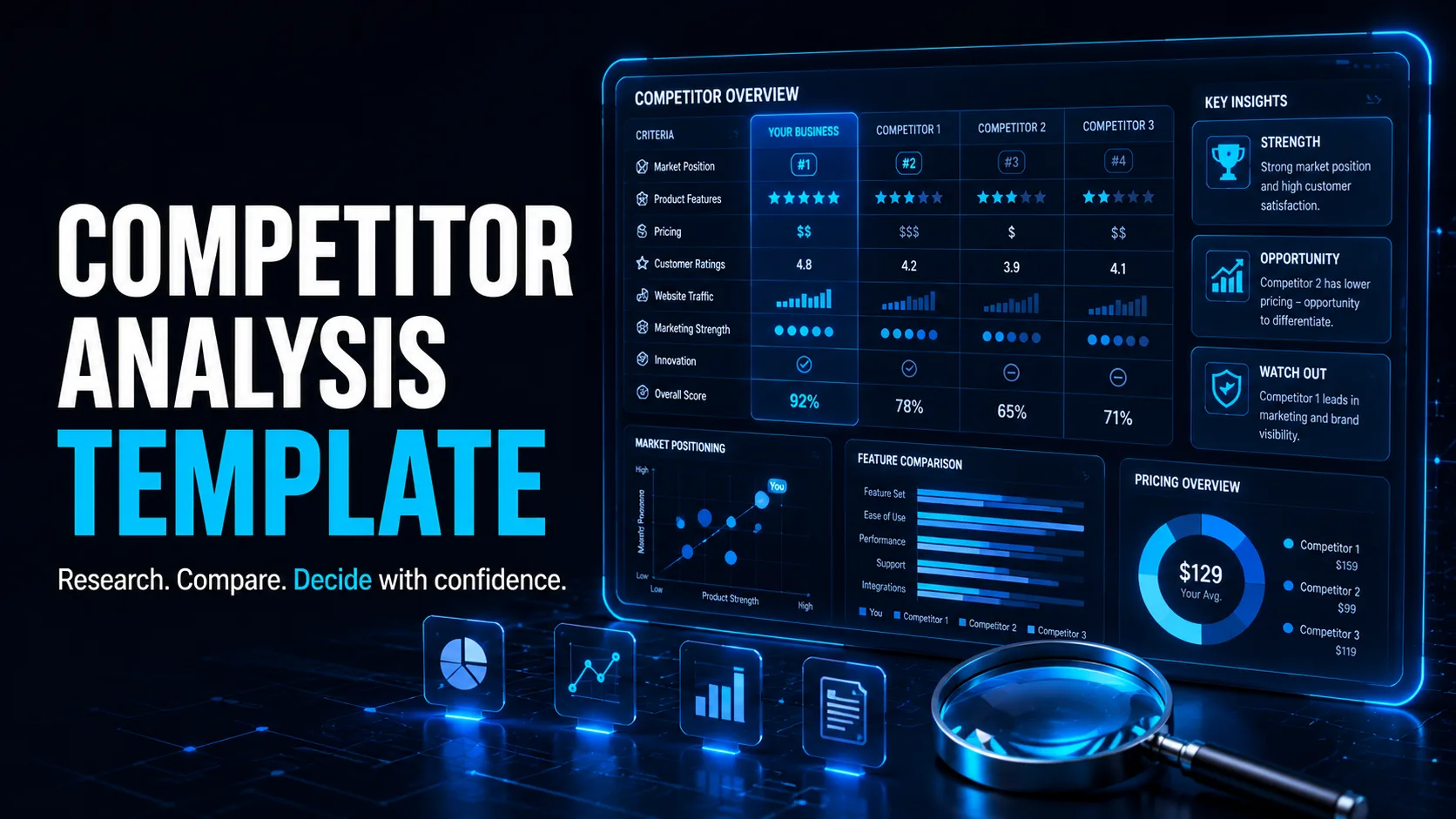
Competitor research is useful only when it leads to a clearer decision.
A long collection of screenshots, pricing pages, product features, reviews, and marketing claims can look impressive while still failing to answer the most important question:
What should we do differently based on this evidence?
A practical Competitor Analysis Template solves that problem by organizing competitors, alternatives, pricing, positioning, customer feedback, and strategic gaps into one repeatable workflow.
The goal is not to decide that one company is universally better. The goal is to understand where meaningful differences exist and which opportunities are worth testing.
What Is a Competitor Analysis Template?
A Competitor Analysis Template is a structured system for comparing businesses, products, services, and substitute solutions using the same criteria.
It can help organize research around:
- target audience;
- positioning;
- product offer;
- pricing;
- customer experience;
- recurring complaints;
- search visibility;
- content strategy;
- distribution channels;
- possible market gaps.
The most important principle is consistency.
If one competitor is evaluated on pricing, reviews, positioning, onboarding, and product limitations, the others should be reviewed using comparable criteria.
Otherwise, the analysis becomes subjective.
Start With the Decision You Need to Make
Do not begin by listing competitors.
Begin with the decision the research must support.
A weak objective is:
Understand the competition.
A stronger objective is:
Determine whether a simpler project management product could compete for small remote teams through faster onboarding and clearer pricing.
The second objective immediately narrows the research.
Before using the Competitor Analysis Template, define:
Decision
What decision will the research support?
Target Customer
Who is choosing or buying the solution?
Problem
What need are they trying to solve?
Market
Which geography or customer segment matters?
Evidence Period
How current must the information be?
Output
Should the research produce a positioning idea, pricing test, product decision, content opportunity, or market hypothesis?
This keeps the project focused and prevents unnecessary research.
Separate Direct, Indirect, and Substitute Competitors
Not every competitor looks like the same product.
A useful Competitor Analysis Template should distinguish between three groups.
Direct competitors solve the same problem for roughly the same audience with a similar type of product.
Indirect competitors solve the same or a related problem in a different way.
Substitutes are tools, habits, or workflows customers may use instead of buying the product.
For example, a project-management software company may compete with:
- another project-management platform;
- a broader collaboration suite;
- spreadsheets;
- email;
- manual workflows;
- internal templates.
Sometimes the strongest competitor is not another brand.
It is the customer’s current process.
Use a Practical Competitor Analysis Matrix
Use the same fields for every important competitor.
| Type | Positioning | Pricing Metric | Main Strength | Review Weakness |
|---|---|---|---|---|
| Direct | Specialized solution | Per user | Deep functionality | Complex setup |
| Direct | Simpler small-team tool | Per workspace | Ease of use | Fewer advanced features |
| Indirect | Broader collaboration platform | Per user | Multiple tools in one system | Less specialized workflow |
| Substitute | Spreadsheet/manual process | Low software cost | Familiar and flexible | More manual work |
This matrix gives the Competitor Analysis Template a clear starting point without creating an oversized spreadsheet.
Each field should be supported by evidence.
For example:
Positioning should come from the competitor’s own website or campaign messaging.
Pricing Metric should come from the current pricing page.
Review Weakness should come from repeated patterns across credible customer feedback, not one isolated complaint.
Compare Outcomes, Not Just Features
Feature counts are easy to collect but often misleading.
Customers care about what the feature helps them accomplish.
Instead of recording only:
Feature: Automated reports
also record:
Customer outcome: Less manual reporting work.
Instead of:
Feature: One-click import
record:
Customer outcome: Faster migration and lower setup friction.
A strong Competitor Analysis Template connects features to outcomes because this is where real differentiation becomes easier to see.
Analyze Pricing in Context
Headline price is only one part of the pricing model.
For each important competitor, check:
- entry price;
- billing frequency;
- free tier or trial;
- user limits;
- usage limits;
- feature restrictions;
- required upgrades;
- add-ons;
- annual discounts.
Also identify the value metric controlling the cost.
A product may charge by:
- user;
- workspace;
- project;
- client;
- storage;
- usage;
- transaction;
- feature tier.
Two products with similar advertised prices can create very different costs for the same customer.
Record when the pricing information was checked because this data can change quickly.
Study Positioning and Messaging
Two competitors with similar products may communicate completely different value.
One may emphasize:
Simplicity
Another:
Speed
Another:
Customization
Another:
Security
Another:
Low cost
The Competitor Analysis Template should record:
- headline promise;
- primary audience;
- main pain point;
- key differentiator;
- proof used;
- primary CTA.
Then compare the promise with the available evidence.
A competitor may claim simplicity while requiring complicated onboarding.
Another may emphasize affordability while important features sit behind expensive plans.
Those gaps between messaging and experience can reveal useful opportunities.
For turning product capabilities into clearer customer benefits, the Product Description Expert provides a separate framework for translating features into customer-facing value.

Use Customer Signals to Find Real Market Gaps
Competitor websites show how companies want to be perceived. Reviews, support discussions, community posts, and user feedback can reveal where customers actually struggle.
A useful Competitor Analysis Template should look for repeated patterns, not isolated complaints.
Common signals may include:
- difficult onboarding;
- confusing pricing;
- weak customer support;
- missing integrations;
- poor mobile experience;
- slow workflows;
- limited reporting;
- complicated cancellation;
- praise for one especially useful feature.
The important question is not simply whether feedback is positive or negative.
Ask:
What expectation is behind the feedback?
For example, repeated complaints about setup time may reveal that speed matters more than feature depth for a certain customer group.
Repeated frustration with pricing may show that the pricing structure does not match how customers actually use the product.
Add Customer Evidence to the Competitor Matrix
The comparison should connect company claims with customer signals.
A compact extension to the Competitor Analysis Template can use:
| Competitor | Positioning | Pricing Metric | Repeated Weakness | Evidence Source |
|---|---|---|---|---|
| Competitor A | Powerful all-in-one tool | Per user | Complex setup | Official site + reviews |
| Competitor B | Simple small-team solution | Per workspace | Limited advanced reporting | Docs + reviews |
| Substitute | Spreadsheet workflow | Low cost | Manual maintenance | User interviews |
This prevents the research from depending only on marketing pages.
If a competitor claims simplicity but customer feedback repeatedly mentions difficult setup, that contrast deserves attention.
Find SEO and Content Gaps
Competitor research can also reveal how brands capture demand through search and content.
A Competitor Analysis Template can record:
- topics competitors publish;
- search intent they appear to target;
- article depth;
- content formats;
- comparison pages;
- tutorials;
- FAQs;
- lead magnets;
- video content;
- missing customer questions.
The goal is not to copy competitor content.
The goal is to identify where the audience still needs a better answer.
For example, a competitor may rank for a broad keyword but provide only a generic overview.
Another may publish many feature pages while ignoring practical tutorials.
Those gaps can become opportunities if you can create something genuinely more useful.
For search-focused content planning, the SEO Blog Writer Prompt can help turn verified opportunities into structured long-form content.
Evaluate Marketing Channels
Competitors build visibility through more than websites.
Compare where they appear across:
- search;
- email;
- YouTube;
- social platforms;
- communities;
- partnerships;
- newsletters;
- paid campaigns.
This can reveal whether a competitor is mainly capturing existing demand or actively creating demand through education and repeated exposure.
A strong channel opportunity is not automatically the platform where competitors publish most often.
It is the channel where:
- your audience is active;
- competitors leave useful gaps;
- your team can produce suitable content consistently.
If social publishing becomes part of the action plan, the Social Media Calendar can help organize the workflow.
Use a Weighted Competitor Scorecard
After the research is organized, use a weighted scorecard to compare what matters most to the target customer.
First, assign each criterion an importance weight.
Then score each competitor from 1 to 5.
Example:
| Criterion | Weight | Competitor A | Competitor B |
|---|---|---|---|
| Ease of Setup | 25% | 2 | 5 |
| Pricing Clarity | 20% | 3 | 4 |
| Core Features | 20% | 5 | 3 |
| Integrations | 15% | 5 | 3 |
| Customer Support | 10% | 3 | 4 |
| Reporting | 10% | 5 | 3 |
To calculate a weighted result:
Score × Weight
For example:
If Competitor A scores 2 for Ease of Setup and the weight is 25%, the weighted value is:
2 × 0.25 = 0.50
Repeat this for every criterion and add the values.
The point is not to create a fake scientific ranking.
The scorecard helps make trade-offs visible.
A competitor may perform extremely well overall while still being weak in the exact area your target customer values most.
Practical Example: Comparing Two Software Tools
Suppose a small remote team is comparing two project-management platforms.
Competitor A
Positioning: Advanced platform for growing teams
Pricing Metric: Per user
Strength: Strong automation and reporting
Weakness: More complex onboarding
Customer Signal: Some reviews mention setup difficulty
Competitor B
Positioning: Simple collaboration for small teams
Pricing Metric: Per workspace
Strength: Fast onboarding and clear interface
Weakness: Fewer advanced reporting options
Customer Signal: Reviews often praise ease of use
Now suppose the target customer values:
- fast setup;
- predictable pricing;
- basic automation;
- easy collaboration.
In that case, Competitor B may fit the customer priorities better even if Competitor A has more features.
That is why a Competitor Analysis Template should connect product capabilities to customer priorities instead of counting features.
Use AI to Organize Research, Not Invent It
AI can help speed up competitor analysis by:
- organizing notes;
- extracting repeated themes;
- comparing structured fields;
- identifying missing questions;
- summarizing verified reviews;
- preparing scorecards;
- drafting research tables.
But AI should not invent:
- prices;
- customer quotes;
- product features;
- review sentiment;
- traffic estimates;
- company strategy;
- market share;
- recent product changes.
Important competitor facts should remain connected to real evidence.
For deeper source verification, the AI Research Assistant provides a separate workflow focused on evidence quality and source checking.
Ready-to-Use Competitor Analysis Master Prompt
Role:
Act as a structured competitor research analyst.

Industry:
[INSERT INDUSTRY]

Target Customer:
[DESCRIBE THE CUSTOMER]

Decision:
[WHAT BUSINESS DECISION SHOULD THIS RESEARCH SUPPORT?]

Competitors:
[LIST DIRECT COMPETITORS]

Indirect Alternatives:
[LIST INDIRECT OR SUBSTITUTE OPTIONS]

Verified Sources:
[INSERT OFFICIAL WEBSITES, PRICING PAGES, DOCUMENTATION, REVIEWS, OR RESEARCH SOURCES]

Evaluation Criteria:
[PRICING / POSITIONING / FEATURES / ONBOARDING / SUPPORT / CONTENT / SEO / REVIEWS / OTHER]

Rules:
- Use only information supported by the provided or verified sources.
- Do not invent prices, features, reviews, statistics, customer quotes, or market claims.
- Clearly label missing or uncertain information.
- Separate company marketing claims from independent evidence.
- Record the source used for every important claim.
- Do not treat one review as a general market pattern.
- Flag outdated information.

Tasks:
1. Classify each competitor as direct, indirect, or substitute.
2. Compare positioning and pricing structure.
3. Identify repeated customer strengths and weaknesses.
4. Build a weighted scorecard using the evaluation criteria.
5. Identify evidence-based market gaps.
6. Suggest one practical hypothesis to test.

Output:
- Competitor matrix
- Weighted scorecard
- Verified strengths
- Verified weaknesses
- Market gaps
- Missing information
- Recommended test
This gives the Competitor Analysis Template a repeatable AI-assisted workflow without allowing the model to fill missing information with guesses.

Verify Competitor Data Before Acting on It
A Competitor Analysis Template is only useful when the information inside it is current and verifiable.
Before using a finding in a decision, check:
- Is the pricing current?
- Is the feature still available?
- Does the limitation apply to the same plan or customer type?
- Is the review recent enough to matter?
- Is the complaint repeated across several sources?
- Does the source refer to the same market or region?
- Is the competitor claim marketing language or independently supported evidence?
Do not treat one screenshot, one review, or one outdated pricing page as enough evidence for a strategic decision.
Use a Final Verification Checklist
Before completing the analysis, review the most important claims.
Competitor Identity
- Are the competitors correctly classified as direct, indirect, or substitute?
- Are irrelevant companies excluded?
- Does each competitor actually serve the target customer or problem?
Pricing
- Was pricing checked on the current official pricing page?
- Are billing frequency and plan limits recorded?
- Are required upgrades or add-ons included?
- Is the pricing model compared on the same basis?
Product and Features
- Are important features confirmed in official documentation?
- Are plan restrictions recorded?
- Are outdated features removed?
- Are marketing claims separated from verified capabilities?
Customer Feedback
- Are weaknesses based on repeated patterns rather than one complaint?
- Are reviews recent and relevant?
- Are unusual or extreme reviews treated cautiously?
- Is customer language separated from your own interpretation?
Positioning
- Does the headline promise come from the competitor’s current messaging?
- Is the target audience clear?
- Is the positioning supported by the actual product experience?
Evidence
- Can every important conclusion be traced back to a source?
- Are uncertain claims labeled?
- Are missing facts left blank instead of guessed?
This checklist protects the Competitor Analysis Template from becoming a collection of assumptions.
Turn Research Into One Testable Action
The final purpose of competitor research is not to create the longest report possible.
It is to decide what should happen next.
A useful action might be:
- test a clearer positioning statement;
- simplify one part of pricing;
- improve onboarding;
- create a missing comparison page;
- publish a stronger tutorial;
- test a different CTA;
- interview customers about a repeated pain point;
- prototype a simpler workflow;
- improve a feature competitors handle poorly.
The action should be narrow enough to test.
Instead of:
Beat Competitor A on onboarding.
Use:
Test whether a three-step onboarding flow reduces first-session setup time for new users compared with the current process.
That creates a measurable hypothesis rather than a vague strategic ambition.
Build an Action Priority Framework
Not every competitor gap deserves immediate attention.
A simple decision filter can use four questions:
Customer Importance
Does the issue matter to the target customer?
Evidence Strength
Is the gap supported by reliable evidence?
Business Relevance
Would fixing it support the product or growth strategy?
Execution Effort
Can the improvement be tested realistically?
For example:
| Opportunity | Customer Importance | Evidence Strength | Effort | Action |
|---|---|---|---|---|
| Faster onboarding | High | Strong | Medium | Test |
| New social platform | Low | Weak | High | Ignore |
| Clearer pricing page | High | Strong | Low | Prioritize |
| Advanced feature gap | Medium | Partial | High | Research more |
This prevents the Competitor Analysis Template from producing an endless list of ideas with no priority.
Review Competitor Content Without Copying It
Competitor content analysis should focus on what the audience still needs.
Look at:
- search topics;
- comparison pages;
- tutorials;
- FAQs;
- video content;
- downloadable resources;
- customer questions;
- content depth;
- update frequency.
Then ask:
What useful question is still poorly answered?
That is more valuable than copying the same keyword or article structure.
If several competitors cover a topic superficially, there may be an opportunity to create something more practical, current, or specific.
The AI Prompts section can support additional research, writing, and planning workflows after the opportunity has been verified.
Keep the Competitor Analysis Current
Competitive research becomes outdated quickly.
Pricing changes.
Features move between plans.
Positioning changes.
New competitors enter the market.
Customer expectations shift.
For that reason, record:
- date checked;
- source URL;
- product version;
- pricing version;
- market or region;
- unresolved questions.
A Competitor Analysis Template should be reviewed periodically rather than treated as a permanent snapshot.
The frequency depends on the market.
A fast-moving software market may require more frequent updates than a stable local service category.
Avoid Common Competitor Research Mistakes
A useful analysis can still fail when the process becomes biased or too broad.
Avoid:
- choosing competitors only because they are well known;
- comparing different plans as if they were equivalent;
- treating one review as a market trend;
- copying competitor features without understanding customer value;
- assuming high visibility means high customer satisfaction;
- using outdated prices;
- confusing marketing claims with evidence;
- using AI-generated facts without source verification;
- scoring criteria that do not matter to the target customer;
- turning the analysis into a feature-counting contest.
The Competitor Analysis Template should reduce bias, not formalize it.
Example: From Competitor Research to an Action
Suppose the research finds:
Competitor A
- strong automation;
- higher setup complexity;
- per-user pricing;
- repeated complaints about onboarding.
Competitor B
- simpler interface;
- clearer pricing;
- fewer advanced features;
- positive feedback around ease of use.
The target customer is a small remote team that values speed and simplicity more than advanced customization.
The research may suggest a hypothesis:
Small teams may respond better to a product positioned around fast setup and predictable pricing than to a feature-heavy alternative.
The next step is not to declare that hypothesis correct.
The next step is to test it.
Possible tests include:
- a landing page with the new positioning;
- onboarding interviews;
- pricing preference surveys;
- prototype usability tests;
- CTA experiments;
- sales-call feedback.
This is where a Competitor Analysis Template becomes a decision tool instead of a research archive.
Strengthen Every Competitor Analysis Template
Before using the final findings, confirm that the analysis includes:
- direct, indirect, and substitute competitors;
- verified positioning;
- current pricing structure;
- repeated customer signals;
- content and channel gaps;
- weighted scoring;
- source verification;
- clear uncertainty labels;
- one practical next action.
A strong Competitor Analysis Template should make the evidence easier to inspect and the decision easier to explain.
It should not create false certainty.
A practical Competitor Analysis Template helps keep research focused on evidence instead of assumptions. The Competitor Analysis Template should compare competitors using the same criteria, record where important claims come from, and highlight only gaps that can actually be supported.
A reliable Competitor Analysis Template also helps teams connect pricing, positioning, customer feedback, and content opportunities to the priorities of the target audience. This makes the research easier to review and more useful for real decisions.
When updated regularly, the Competitor Analysis Template can support clearer product, pricing, SEO, and content decisions as competitors change their offers and messaging. A strong Competitor Analysis Template helps turn verified competitor data into clearer, more practical business decisions.
Used properly, the Competitor Analysis Template becomes a repeatable decision-making tool rather than a static research document. The Competitor Analysis Template is most valuable when the final findings lead to one practical action that can be tested.
Access the Complete Competitor Analysis Template
The downloadable Competitor Analysis Template PDF is an optional companion to the full workflow explained above.
The article already provides the core tools directly on the page, including:
- competitor classification;
- comparison matrix;
- pricing and positioning analysis;
- customer signal review;
- content and channel analysis;
- weighted scorecard;
- practical software comparison;
- Master Prompt;
- verification checklist;
- action-priority framework.
The PDF adds reusable worksheets, expanded comparison tables, longer examples, printable scoring formats, and repeatable research templates.
The download is therefore a working resource for repeated projects rather than a requirement for understanding the method.
Help Us Create More Free Resources
Digital World Pulse creates practical guides, useful tools, and downloadable resources that are freely available to everyone. Every resource requires time, research, hosting, design, testing, and software.


If you found this Competitor Analysis Template helpful, you can support our work through PayPal or Revolut. Your contribution is completely optional, and any amount—even the price of a coffee —helps us remain independent and create more valuable free resources.
Thank you for supporting Digital World Pulse and helping us continue this journey!
Our AI and technology content is developed through hands-on testing, official documentation review, product research, software evaluation, and workflow verification where applicable.
Where applicable, prompts, workflows, software features, and processes are tested directly before publication to verify how they work in real-world use.
Yes. AI tools and software platforms can change quickly, including interfaces, features, model capabilities, usage limits, and pricing.
Yes. AI-generated output can be incomplete, inconsistent, or inaccurate, so important results should be reviewed and verified by a human.
Articles may be updated when important changes occur to tools, interfaces, pricing, model capabilities, software behavior, or workflows.