

Research becomes difficult long before the writing starts. A single project can quickly produce dozens of browser tabs, conflicting statistics, duplicated notes, outdated sources, and claims that are difficult to trace back to their origin.
An AI Research Assistant can make that process more manageable by helping you define the question, organize searches, compare evidence, extract important details, and prepare structured notes before drafting a final answer.
The important distinction is that AI should support research, not replace verification.
A model can summarize an unreliable page just as confidently as an authoritative report. It can also misunderstand context, combine incompatible evidence, or generate a citation that looks plausible but does not support the claim.
For that reason, the most useful AI Research Assistant workflow combines automation with source checking, human judgment, and a clear record of where each important fact came from.
This guide provides a practical research system you can use for:
- academic research;
- business analysis;
- competitor research;
- content creation;
- product comparisons;
- technical research;
- market research;
- general fact-finding.
The objective is not simply to collect more information. It is to create research that can be checked, updated, and explained.
What Is an AI Research Assistant?
An AI Research Assistant is a tool or structured prompt workflow that helps with specific stages of research.
Depending on the task, it can help you:
- turn a broad topic into focused research questions;
- generate useful search terms;
- identify likely primary and secondary sources;
- extract information from documents;
- compare claims across multiple sources;
- organize evidence into tables;
- identify missing information;
- prepare citation records;
- create an outline based on verified material.
The most valuable role is usually not automatic writing.
It is research organization.
For example, imagine you want to compare three AI meeting tools for a small remote company.
A weak request would be:
Compare the best AI meeting tools.
That leaves too many decisions undefined.
A stronger research brief would say:
Compare three AI meeting tools for a five-person remote team. Focus on searchable meeting transcripts, consent controls, export options, integrations, pricing, and data retention. Use current official product documentation where possible. Separate confirmed product features from marketing claims and identify any information that cannot be independently verified.
The second version gives the AI Research Assistant a clear audience, use case, comparison criteria, evidence standard, and verification rule.
That dramatically improves the usefulness of the research.
Define the Research Question Before Searching
A good research process starts with a question that is specific enough to investigate.
Before asking the AI to search, summarize, or compare anything, define:
Primary question
What exactly are you trying to understand?
Audience
Who will use the final research?
Decision or deliverable
Will the research support an article, purchase decision, strategy, report, presentation, or internal recommendation?
Time period
Does the information need to be current, historical, or limited to a specific date range?
Geographic scope
Does the answer depend on a particular country, market, or population?
Evidence requirements
Do you need official documentation, academic studies, government data, company filings, datasets, or multiple independent sources?
Exclusions
Are there sources, topics, assumptions, or regions that should not be included?
A practical research brief could look like this:
| Research Field | Example |
|---|---|
| Question | Which AI meeting tool fits a small remote team? |
| Audience | Five-person software company |
| Scope | Current products available in 2026 |
| Priorities | Transcripts, consent, exports, integrations |
| Preferred Sources | Official documentation and reliable reviews |
| Exclusions | Unverified feature claims |
| Output | Comparison with limitations and sources |
This short brief gives the AI Research Assistant clear boundaries before information gathering begins.
Separate Discovery From Verification
One of the most common research mistakes is treating the first useful search result as evidence.
Discovery and verification should be separate steps.
During discovery, the goal is to identify:
- relevant documents;
- useful terminology;
- organizations involved;
- original studies;
- datasets;
- official documentation;
- competing explanations.
During verification, the goal changes.
Now you check whether the source actually supports the claim, whether the information is current, and whether important limitations are being ignored.
For example, an AI-generated summary might say:
Tool A supports unlimited meeting transcription.
Do not copy that statement directly into a report.
Open the product documentation and confirm:
- whether transcription is actually unlimited;
- which plan includes it;
- whether usage restrictions apply;
- whether the feature is available in every region;
- when the documentation was last updated.
The AI Research Assistant can help locate and organize the evidence, but the final claim should come from the evidence itself.
For broader AI workflows, the AI Productivity Toolkit provides additional systems for organizing recurring tasks, while the AI Prompts collection includes reusable frameworks for other AI-assisted workflows.

Build a Source Evaluation Framework
Once useful sources have been discovered, evaluate them before adding their claims to the research.
A strong AI Research Assistant should not assign one vague “trust score.” It is better to review each source using several separate criteria.
Relevance
Does the source directly answer the research question?
Check whether it matches the required:
- topic;
- audience;
- geographic region;
- time period;
- product version;
- population;
- outcome being measured.
A credible source can still be irrelevant if it studies the wrong context.
Authority
Identify who created the source.
Ask:
- Is the author named?
- Is the organization identifiable?
- Does the source explain its expertise or methodology?
- Is there an editorial or review process?
- Can the original publication be accessed directly?
Anonymous summaries and copied content should be treated with additional caution.
Method
When research includes studies, surveys, benchmarks, or datasets, review how the evidence was produced.
Important details may include:
- sample size;
- participant selection;
- definitions;
- measurement method;
- comparison groups;
- data collection period;
- known limitations.
The conclusion should never be stronger than the method allows.
Currency
Some information becomes outdated quickly.
This is especially important for:
- AI tools;
- software features;
- pricing;
- laws;
- platform rules;
- product specifications;
- market statistics.
An AI Research Assistant should record the publication or update date and flag material that may require a newer source.
Independence
Check whether the source has commercial or organizational incentives.
A company can provide excellent documentation about its own product, but its marketing claims should not automatically be treated as independent evidence.
Whenever possible, separate:
First-party information — what the organization says about itself.
Independent evidence — what external studies, reviewers, regulators, datasets, or users can verify.
Create a Practical Evidence Table
One of the most useful parts of an AI Research Assistant workflow is a structured evidence table.
Instead of saving disconnected notes, create one record for each important claim.
A compact version can use:
| Claim | Source | Evidence | Limits | Status |
|---|---|---|---|---|
| Tool supports transcript export | Official docs | Export formats listed | Plan restrictions possible | Verified |
| Feature improves productivity | Vendor case study | Reported time savings | Vendor-created evidence | Limited |
| New rule applies in 2026 | Official regulator page | Effective date confirmed | Region-specific | Verified |
| Product is “best in class” | Marketing page | Promotional statement | No independent benchmark | Unsupported |
This format helps separate evidence from interpretation.
It also makes later fact-checking much faster.
Use Clear Verification Status Labels
For each important claim, assign a status.
A simple system works well:
Verified — directly supported by a suitable source.
Partially Verified — evidence exists, but important limitations remain.
Disputed — credible sources reach different conclusions.
Outdated — a newer rule, figure, version, or document exists.
Unsupported — no reliable evidence has been found.
These labels prevent polished writing from hiding weak evidence.
The AI Research Assistant should never convert “unsupported” into “probably true” just to complete the report.
Compare Sources Instead of Summarizing Them Separately
Research becomes more useful when sources are compared against the same question.
Group findings into:
- areas of agreement;
- conditional findings;
- direct contradictions;
- different definitions;
- weak or indirect evidence;
- unanswered questions.
Suppose two reports appear to disagree about whether an AI tool improves productivity.
One study may measure task completion speed.
Another may measure employee satisfaction.
The conclusions may look contradictory even though they measure different outcomes.
A good AI Research Assistant should identify that difference before combining the findings.
Resolve Conflicting Evidence Carefully
When sources disagree, investigate why.
Possible reasons include:
- different populations;
- different time periods;
- different definitions;
- different sample sizes;
- different product versions;
- different geographic markets;
- different methodologies;
- different incentives;
- incomplete data.
Do not force a single conclusion when the evidence does not support one.
Instead, write the result proportionally.
For example:
The available evidence suggests that the tool can reduce manual note-taking in some workflows, but the size of the benefit varies by team structure, meeting type, and implementation method.
That is more useful than claiming the tool “proves” a universal productivity improvement.
Create a Claim Inventory Before Writing
Before drafting the final article or report, create a list of the material claims you expect to use.
Include:
- statistics;
- dates;
- product features;
- quotations;
- definitions;
- prices;
- legal or regulatory statements;
- scientific conclusions;
- company claims;
- market figures.
Then connect each claim to its evidence source and verification status.
This step is especially useful when the final content will be public.
For content-focused research, the SEO Blog Writer Prompt can help turn verified material into a structured article after the evidence has already been checked.
Use the AI Research Assistant Master Prompt
Use this prompt after the research question and source requirements are defined:
Role:
Act as a rigorous AI Research Assistant.

Research Question:
[INSERT THE MAIN QUESTION]

Audience:
[WHO WILL USE THE RESEARCH?]

Purpose:
[ARTICLE / REPORT / DECISION / PRESENTATION / COMPARISON]

Scope:
[DATES / LOCATION / POPULATION / PRODUCT VERSION / EXCLUSIONS]

Preferred Sources:
[OFFICIAL DOCUMENTATION / PRIMARY SOURCES / PEER-REVIEWED RESEARCH / DATASETS / REGULATORY SOURCES]

Tasks:
1. Break the main question into focused subquestions.
2. Create a search strategy for each subquestion.
3. Prioritize original and authoritative sources.
4. Record each material claim with its source.
5. Separate direct evidence from source interpretation and your own inference.
6. Identify disagreement between sources.
7. Flag outdated, unsupported, or unverifiable claims.
8. Record important limitations.
9. Do not invent citations, statistics, quotations, dates, or URLs.
10. Do not increase certainty beyond what the evidence supports.

Output:
- Research questions
- Search strategy
- Source list
- Evidence table
- Conflicting findings
- Verification status for each major claim
- Unresolved questions
- Final synthesis based only on verified evidence
- Citation audit
This prompt gives the AI Research Assistant a research process instead of simply asking for an answer.
Verify Every Citation Before Publication
Never assume that a citation is correct because it looks professional.
Open the original source and confirm:
- the page exists;
- the author or organization is correct;
- the publication date is accurate;
- the quoted or summarized information actually appears there;
- the source supports the specific claim;
- the document is not outdated;
- the link points to the intended page.
For academic discovery, Google Scholar can help locate papers and citation trails.
Crossref can help verify DOI and publication metadata, while the Directory of Open Access Journals can help locate open-access academic material.
These services help with discovery and metadata, but the original source should still be checked before a claim is published.
Keep Research Notes Separate From Final Conclusions
A useful AI Research Assistant workflow should keep four things distinct:
Source evidence — what the document directly states.
Source interpretation — how the author explains the evidence.
Researcher interpretation — how you understand the evidence.
Final conclusion — what can reasonably be stated after comparing the available material.
Mixing these stages can create false certainty.
The evidence should come first.
The conclusion should come last.
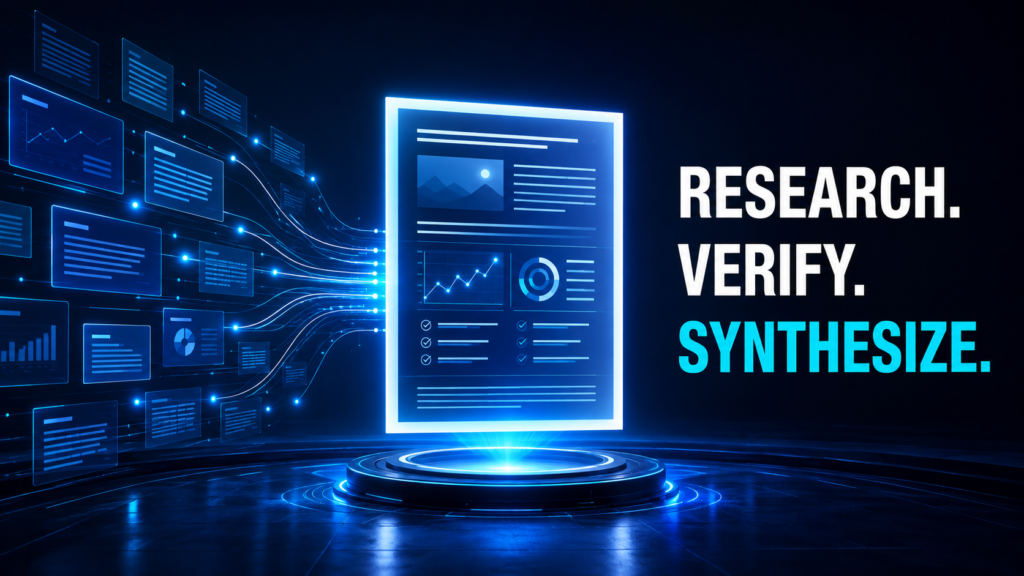
Turn Verified Evidence Into a Clear Research Synthesis
After the evidence has been collected and checked, the AI Research Assistant can help organize the findings into a final structure.
The synthesis should not simply repeat every source.
It should answer:
- what is strongly supported;
- what is only conditionally supported;
- where sources disagree;
- what remains uncertain;
- what information may already be outdated;
- which conclusions depend on context.
A useful final report can follow this order:
Question → Evidence → Comparison → Limitations → Conclusion → Unresolved Issues
This keeps the reasoning transparent and makes the final answer easier to review.
Match the Language to the Strength of the Evidence
Research becomes misleading when cautious evidence is rewritten as certainty.
Use language that reflects what the sources actually support.
Examples:
Strong support
“Multiple independent sources consistently report…”
Moderate support
“The available evidence suggests…”
Conditional result
“This appears to be useful when…”
Conflict
“Sources disagree, partly because…”
Uncertainty
“Current evidence is insufficient to determine…”
Outdated evidence
“An older source reported this, but newer documentation should be checked.”
An AI Research Assistant should preserve uncertainty rather than smoothing it away.
Use a Final Research Quality Check
Before publishing or relying on the final report, review the research one more time.
Check:
- Is the main question answered directly?
- Are important claims linked to suitable evidence?
- Are first-party claims clearly separated from independent evidence?
- Are outdated sources identified?
- Are conflicting findings explained?
- Are limitations visible?
- Are statistics tied to the correct population and period?
- Are quotations accurate?
- Are citations real and accessible?
- Are unsupported claims removed or qualified?
- Is interpretation separated from fact?
For high-impact topics such as medical, legal, financial, scientific, or regulatory decisions, professional or domain-specific review may still be necessary.
Use AI to Save Time Without Automating Judgment
An AI Research Assistant can reduce repetitive work in several useful areas.
It can help:
- summarize long documents;
- extract recurring themes;
- classify evidence;
- create research tables;
- identify missing questions;
- compare multiple documents;
- generate follow-up queries;
- prepare structured notes;
- organize citations;
- draft a synthesis from verified material.
But some tasks should remain under human control:
- deciding whether a source is sufficiently authoritative;
- judging whether evidence is applicable to the real question;
- interpreting conflicting results;
- approving high-impact claims;
- determining whether uncertainty is acceptable;
- making the final recommendation or conclusion.
The objective is faster organization, not automated truth.
Create a Repeatable Research Workflow
A practical workflow can look like this:
1. Define the question
Clarify audience, purpose, scope, and evidence requirements.
2. Plan the search
Break the topic into smaller subquestions.
3. Discover sources
Locate official, primary, academic, or otherwise suitable evidence.
4. Evaluate sources
Check relevance, authority, method, currency, and independence.
5. Build the evidence table
Record claims, sources, limitations, and verification status.
6. Compare findings
Identify agreement, disagreement, and evidence gaps.
7. Verify citations
Open the original material and confirm every important reference.
8. Draft the synthesis
Write only from verified evidence.
9. Review uncertainty
Check whether conclusions are stronger than the evidence.
10. Archive the research
Save sources, notes, dates, and unresolved questions for future updates.
This workflow makes the AI Research Assistant easier to use consistently across different projects.
Example: Researching a Software Purchase
Suppose a small business wants to compare three project management platforms.
The research brief might include:
Question: Which platform is the best operational fit for a remote team of eight?
Priorities:
Task management, permissions, automation, reporting, integrations, pricing, data export, and mobile access.
Preferred sources:
Official documentation, pricing pages, help centers, security documentation, and recent independent comparisons.
The AI Research Assistant can then build a comparison table and flag items such as:
Platform A
Automation is available, but usage limits differ by plan.
Platform B
Data export is documented, but some advanced reporting features require a higher tier.
Platform C
Mobile access is supported, but the available evidence does not clearly confirm one requested integration.
The final recommendation should not pretend all information is equally certain.
A better conclusion would explain which requirements are verified, which depend on plan level, and which still need direct confirmation.
Common AI Research Mistakes to Avoid
Even a well-designed AI Research Assistant workflow can fail if the process becomes too automated.
Avoid:
- trusting citations without opening them;
- using search snippets as evidence;
- relying on one source for an important claim;
- accepting marketing claims as neutral evidence;
- ignoring publication dates;
- mixing different populations or markets;
- treating correlation as causation;
- hiding conflicting findings;
- removing uncertainty to make the report sound stronger;
- assuming a confident AI response is automatically accurate.
Good research is not defined by how quickly an answer is produced.
It is defined by whether the evidence can be inspected.
Keep Research Easy to Update
Many topics change after publication.
Software features change.
Prices change.
Policies change.
Statistics are revised.
New studies appear.
For that reason, keep a simple research archive containing:
- research question;
- source URLs;
- publication dates;
- access dates;
- extracted evidence;
- verification status;
- known limitations;
- final conclusion;
- unresolved questions.
When the topic is reviewed later, the AI Research Assistant can help identify which sources need to be refreshed instead of restarting the entire research process.
Strengthen Every AI Research Assistant Workflow
A reliable AI Research Assistant should make evidence easier to inspect, not harder to trace.
Before using the final output, confirm that the workflow includes:
- a clear research question;
- explicit scope;
- source evaluation;
- claim-level verification;
- evidence tables;
- conflict analysis;
- citation checking;
- visible limitations;
- human review.
The strongest research process is not the one with the most sources.
It is the one where the most important claims can be traced back to suitable evidence.
A well-structured AI Research Assistant helps researchers move from scattered information to a transparent evidence trail that can be reviewed and updated later. The AI Research Assistant should support source discovery, claim verification, comparison, and synthesis while keeping human judgment responsible for deciding whether the final evidence is strong enough to use.
Access the Complete AI Research Assistant Guide
The downloadable AI Research Assistant PDF is an optional companion to the full process explained above.
The article already provides the core workflow directly on the page, including:
- research-question design;
- source evaluation criteria;
- evidence tables;
- verification labels;
- conflict analysis;
- claim inventory;
- master research prompt;
- citation checks;
- synthesis rules;
- final quality review.
The PDF adds reusable worksheets, expanded templates, longer examples, research checklists, and a structured audit format for repeat projects.
The download is therefore a reusable working resource rather than a requirement for understanding the method.
Help Us Create More Free Resources
Digital World Pulse creates practical guides, useful tools, and downloadable resources that are freely available to everyone. Every resource requires time, research, hosting, design, testing, and software.


If you found the AI Research Assistant helpful, you can support our work through PayPal or Revolut. Your contribution is completely optional, and any amount—even the price of a coffee—helps us remain independent and create more valuable free resources.
Thank you for supporting Digital World Pulse and helping us continue this journey!
Our AI and technology content is developed through hands-on testing, official documentation review, product research, software evaluation, and workflow verification where applicable.
Where applicable, prompts, workflows, software features, and processes are tested directly before publication to verify how they work in real-world use.
Yes. AI tools and software platforms can change quickly, including interfaces, features, model capabilities, usage limits, and pricing.
Yes. AI-generated output can be incomplete, inconsistent, or inaccurate, so important results should be reviewed and verified by a human.
Articles may be updated when important changes occur to tools, interfaces, pricing, model capabilities, software behavior, or workflows.