
A strong Email Marketing Campaign should begin with a clear audience, one measurable objective, a relevant offer, and a sequence in which every message has a specific job.
The Email Marketing Campaign framework from Digital World Pulse is designed to help marketers plan, write, review, and improve email sequences without relying on random promotions or generic AI-generated copy.
Instead of asking an AI assistant to “write a sales email,” the workflow defines the segment, campaign objective, sequence stage, CTA, offer, proof, compliance limits, and review criteria before drafting begins.
The goal is not to send more email for the sake of activity. It is to send more relevant messages with clearer reasoning behind every subject line, paragraph, offer, and call to action.
Artificial intelligence can accelerate research, drafting, variation, and analysis, but the human marketer remains responsible for consent, accuracy, customer expectations, brand voice, and final approval.
What Is an Email Marketing Campaign?
An Email Marketing Campaign is a coordinated message or sequence of messages created to move a defined audience toward a specific outcome.
That outcome might include:
- welcoming a new subscriber;
- educating a lead;
- launching a product;
- promoting an event;
- recovering an abandoned cart;
- encouraging a renewal;
- re-engaging inactive subscribers;
- requesting feedback.
A useful campaign connects strategy, audience, offer, copy, automation, deliverability, and measurement.
A clever subject line cannot rescue an irrelevant offer.
A strong discount cannot repair poor list quality.
And polished design cannot compensate for unclear permission or misleading expectations.
The Email Marketing Campaign should work as one connected system.
Build the Campaign Brief Before Writing
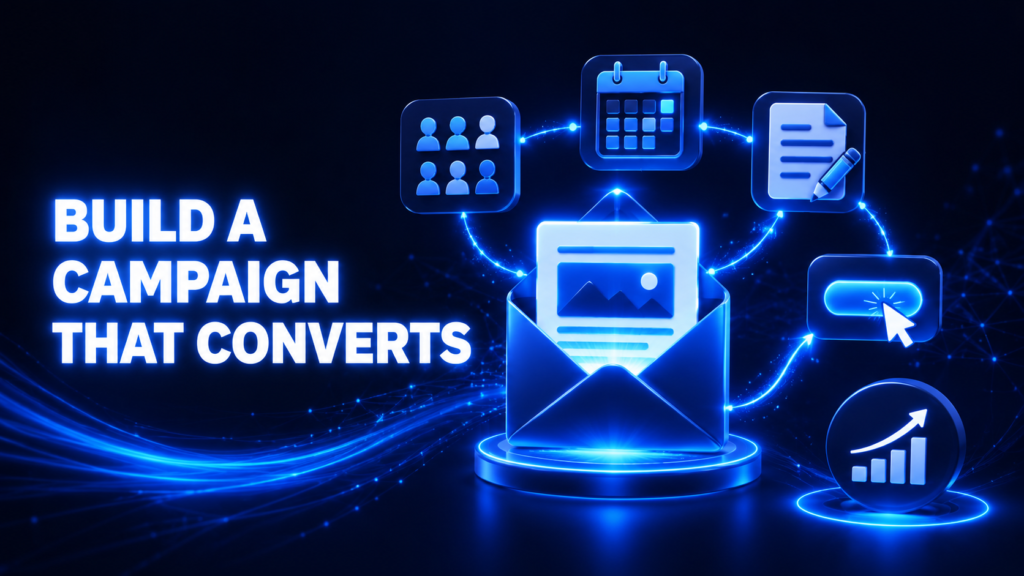
Before creating the first email, define the campaign brief.
A practical brief can include:
| Campaign Field | What to Define |
|---|---|
| Segment | Exact audience receiving the campaign |
| Objective | One measurable business outcome |
| Offer | The value or action being presented |
| Sequence Stage | Welcome, Nurture, Offer, Reminder, Follow-up |
| CTA | One primary action |
| Proof | Evidence supporting the message |
| Timing | Trigger, delay, or send window |
| Exit Condition | When the subscriber should leave the sequence |
| Anti-Spam Constraints | Consent, suppression, truthful claims, unsubscribe rules |
| Success Metric | The main result used to evaluate performance |
This structure gives the Email Marketing Campaign enough context before any AI-generated copy is created.
Without it, the model may produce an attractive email that does not fit the audience, business objective, or stage of the customer journey.
Define One Primary Campaign Objective
A campaign should have one main objective.
“Improve engagement” is usually too broad.
A stronger objective might be:
Move new trial users toward completing their first project within seven days while keeping unsubscribe and complaint rates within normal limits.
Another example:
Encourage subscribers who downloaded a beginner guide to view the advanced workflow page during the next five days.
The objective should define:
Audience: who should act
Current state: where they are now
Desired action: what should happen next
Timeframe: when the action matters
Guardrail: what should not be damaged in the process
A practical formula is:
Move [segment] from [current state] to [desired action] during [timeframe], while protecting [trust or quality condition].
This keeps the Email Marketing Campaign focused on a real business outcome rather than vague activity.
Segment Subscribers by Meaningful Differences
Segmentation matters only when the difference should change the message, timing, offer, or CTA.
Useful segmentation signals can include:
- signup source;
- stated interest;
- customer vs prospect status;
- product category;
- lifecycle stage;
- recent purchase;
- engagement level;
- language;
- geographic region;
- eligibility for an offer.
The goal is not to create dozens of tiny audiences.
The goal is to identify differences that actually matter.
For example:
Segment A: new subscribers who downloaded a beginner AI guide
Need: understand what to do next
Likely objection: too many tools and too much complexity
Desired action: open the starter workflow
Message style: educational and low pressure
A different segment might require a completely different message.
The Email Marketing Campaign should therefore treat audience context as an input, not as decoration added after the copy is already written.
For broader workflow organization, the AI Productivity Toolkit provides additional methods for structuring tasks, tools, and human review.
Create an Offer That Matches the Segment
An offer is not always a discount.
It may be:
- a guide;
- a checklist;
- a free trial;
- a product demonstration;
- a comparison;
- an invitation;
- a webinar;
- a resource download;
- a renewal option;
- a product upgrade;
- a limited promotion.
Before drafting, define exactly what the recipient is being asked to consider.
A useful offer brief should include:
Offer: what the recipient receives
Value: why it matters
Eligibility: who can use it
Conditions: restrictions or requirements
Deadline: only if genuine
Proof: facts supporting the offer
Destination: exact landing page
CTA: the primary action
The Email Marketing Campaign should never allow the AI assistant to invent a discount, deadline, testimonial, product feature, or scarcity claim.
Unknown information should be marked for verification instead.
Design the Campaign Architecture
The campaign architecture defines how many emails are needed and what job each message performs.
More emails do not automatically produce better results.
A simple sequence might use:
Welcome → Nurture → Offer
Each message has a different purpose.
Welcome
Confirm why the subscriber is receiving the email, deliver the expected value, and establish what type of communication comes next.
Nurture
Provide useful information related to the subscriber’s original interest and help them understand the problem or opportunity more clearly.
Offer
Present a relevant next step that naturally follows from the previous messages.
This progression is stronger than sending three promotional emails that repeat the same sales message.
Example: Welcome / Nurture / Offer Sequence
Suppose a subscriber downloads a free guide about improving AI productivity.
A practical Email Marketing Campaign could look like this:
| Stage | Purpose | Example CTA |
|---|---|---|
| Welcome | Deliver the promised resource and set expectations | Open the guide |
| Nurture | Show one practical workflow from the guide | View the workflow |
| Offer | Present a deeper resource for users who want more structure | Explore the toolkit |
Email 1 — Welcome
Subject: Your AI productivity guide is ready
Purpose: Deliver the resource and confirm why the subscriber is receiving the email.
Core message:
Thank the subscriber, provide the promised guide, and explain what they can expect from future messages.
CTA:
Open the guide
Email 2 — Nurture
Subject: One simple way to reduce repetitive AI work
Purpose: Provide value before asking for a commercial action.
Core message:
Explain one practical workflow, such as using a reusable brief before asking an AI assistant to produce content.
CTA:
View the workflow
Email 3 — Offer
Subject: Want the complete workflow in one place?
Purpose: Present a relevant next step based on the subscriber’s demonstrated interest.
Core message:
Explain what additional structure the toolkit provides and who it is most useful for.
CTA:
Explore the toolkit
The Email Marketing Campaign now has a logical progression instead of three disconnected messages.
Ready-to-Use Email Marketing Campaign Master Prompt
Use this prompt after the campaign brief has been verified.
Role:
Act as an experienced email marketing strategist and copywriter.

Segment:
[DEFINE THE EXACT AUDIENCE]

Objective:
[DEFINE ONE PRIMARY CAMPAIGN OBJECTIVE]

Offer:
[DESCRIBE THE VERIFIED OFFER]

Sequence Stage:
[WELCOME / NURTURE / OFFER / REMINDER / FOLLOW-UP]

Customer Context:
[WHAT DOES THIS SEGMENT ALREADY KNOW, NEED, OR EXPECT?]

Primary CTA:
[INSERT ONE PRIMARY ACTION]

Proof:
[INSERT VERIFIED FACTS, BENEFITS, DATA, TESTIMONIALS, OR EVIDENCE]

Brand Voice:
[DEFINE 3–5 VOICE ATTRIBUTES]

Timing:
[TRIGGER / DELAY / SEND WINDOW]

Anti-Spam Constraints:
- Use only subscribers with appropriate permission.
- Do not invent urgency, scarcity, testimonials, results, or deadlines.
- Do not use misleading subject lines.
- Do not imply a previous conversation that did not occur.
- Do not hide material conditions.
- Keep unsubscribe expectations clear.
- Flag any statement that requires legal or factual verification.

Task:
Create one email for the specified sequence stage.

Required Output:
1. Three subject-line options.
2. Two preview-text options.
3. Recommended subject line with reasoning.
4. Email body.
5. One primary CTA.
6. Any secondary link only if genuinely useful.
7. Verification warnings for unsupported or missing information.
8. Short explanation of how this email supports the campaign objective.

Writing Rules:
- Keep the message relevant to the defined segment.
- Use clear, conversational language.
- Avoid exaggerated claims.
- Do not repeat the same argument in multiple paragraphs.
- Make the CTA consistent with the landing-page promise.
- Do not invent customer data or personalization.
This prompt gives the AI assistant specific boundaries instead of asking it to generate an entire campaign from one vague instruction.
Example Master Prompt Input
A completed input could look like this:
Segment: New subscribers who downloaded an AI productivity guide during the last seven days
Objective: Encourage them to view a practical workflow page
Offer: Free AI Productivity Toolkit article and optional downloadable resource
Sequence Stage: Nurture
CTA: View the workflow
Proof: The article includes prompt templates, workflow examples, tool comparisons, and human-review steps
Brand Voice: practical, clear, professional, non-hype
Timing: Two days after the welcome email
Anti-Spam Constraints: no fake urgency, no fabricated results, no misleading “Re:” subject line, no unsupported productivity claims
The output should now be much more focused because the Email Marketing Campaign prompt knows who the recipient is, what stage they are in, what action matters, and which tactics are prohibited.
Build Each Email Around One Primary Action
A campaign becomes harder to follow when every message asks the reader to do several unrelated things.
A useful structure is:
Context → Problem or Goal → Value → Proof → CTA → Qualification
For example:
Context: Why is this email relevant now?
Problem: What is the subscriber trying to solve?
Value: What useful information or offer is available?
Proof: Why should the reader trust the claim?
CTA: What should happen next?
Qualification: Is there an important condition, limitation, or deadline?
The Email Marketing Campaign should normally emphasize one primary CTA.
Secondary links can support readers who need more information, but they should not compete equally with the main decision.
For supporting long-form content, the SEO Blog Writer Prompt can help create articles and guides that email campaigns may link to, while the Product Description Expert supports accurate ecommerce product copy.
Protect Permission and Subscriber Expectations
A strong campaign starts with a legitimate reason to contact the recipient.
The campaign brief should record:
- how the subscriber joined;
- what they were told at signup;
- what type of email they agreed to receive;
- suppression or unsubscribe status;
- geographic or regulatory considerations.
Do not use AI to invent consent records or infer sensitive traits.
Do not assume that an address collected for one purpose can automatically be used for every type of marketing.
The Email Marketing Campaign should preserve subscriber trust before optimizing clicks or conversions.
Prepare the Sequence Before Writing Every Message
Before drafting the full sequence, create a simple map:
Email 1: Welcome — deliver value
Email 2: Nurture — educate
Email 3: Offer — present next step
Email 4: Reminder — only if there is a real reason
Email 5: Follow-up — confirm next step or stop
For every message, define:
- trigger;
- delay;
- purpose;
- reader question;
- proof;
- CTA;
- exit condition.
A subscriber who already completed the desired action should not continue receiving messages asking them to do it again.
This makes the Email Marketing Campaign more relevant and reduces unnecessary automation.
Write Subject Lines and Preview Text That Match the Message
A subject line should set an accurate expectation.
Its job is to help the right recipient understand why the email may be relevant, not to force a click through deception.
Useful approaches include:
- clear benefit;
- specific information;
- relevant question;
- genuine reminder;
- useful curiosity.
Examples:
Clear benefit:A simpler way to plan your weekly content
Specific information:Your 7-day onboarding checklist
Relevant question:Still comparing the two plans?
Genuine reminder:Registration closes Friday
Useful curiosity:The step most campaign briefs miss
The Email Marketing Campaign should avoid fake reply markers, false forwarding labels, fabricated account warnings, or misleading urgency.
The subject line, preview text, sender name, and email body should all support the same promise.
The preview text should add context instead of repeating the subject.
For example:
Subject: Your 7-day onboarding checklist
Preview text: Start with the three setup steps that reduce confusion later.
That combination is more useful than repeating the same phrase twice.
Use a Subject-Line Review Framework
Before approving a subject line, check:
Clarity: does the recipient understand the topic?
Accuracy: does the email deliver what the subject promises?
Relevance: does it fit the defined segment?
Pressure: does it create false urgency?
Identity: is the sender recognizable?
Spam risk: does it rely on exaggerated language or misleading formatting?
A useful AI prompt can ask for multiple options, but the final choice should still be reviewed by a human.
For example:
Create 5 subject-line options for this email.

Segment:
[INSERT SEGMENT]

Sequence Stage:
[INSERT STAGE]

Primary Value:
[INSERT VALUE]

Rules:
- Do not use fake urgency.
- Do not use “Re:” or “Fwd:” unless accurate.
- Do not exaggerate the result.
- Keep the subject aligned with the actual email.
- Avoid unnecessary capitalization and punctuation.

For each option, explain:
1. Main angle
2. Why it fits the segment
3. Potential risk or limitation
This makes subject-line generation more deliberate.
Write Email Copy Without Pressure Tricks
Strong email copy should connect a real audience need with one useful next step.
A practical structure is:
Context → Problem or Goal → Value → Proof → Action → Qualification
For example:
Context:
Why is this message relevant now?
Problem or Goal:
What is the reader trying to solve or achieve?
Value:
How does the resource, product, or action help?
Proof:
What verified evidence supports the message?
Action:
What should the reader do next?
Qualification:
What limitation, eligibility condition, or deadline matters?
The Email Marketing Campaign should avoid vague statements such as:
This revolutionary solution will transform your business.
A stronger version would explain:
The workflow helps organize campaign objectives, sequence stages, and review steps before the first email is sent.
Specific language is easier to trust and easier to review.
Keep One Primary CTA Per Email
Too many calls to action can weaken the message.
A useful campaign email usually has one primary action.
Examples:
- Open the guide
- View the workflow
- Compare the plans
- Register for the event
- Complete setup
- Explore the toolkit
Secondary links may still exist, but they should support rather than compete with the main CTA.
For example:
Primary CTA: View the workflow
Secondary link: Read the FAQ
The Email Marketing Campaign should make it obvious which action matters most.
Match the Landing Page to the Email Promise
The email and destination page should continue the same expectation.
If the email says:
See the 3-step onboarding workflow
the landing page should actually show that workflow.
It should not redirect the reader to an unrelated homepage or force them through a different offer first.
Before sending, verify:
- CTA URL;
- page title;
- offer;
- price;
- deadline;
- product availability;
- mobile rendering;
- tracking parameters;
- form functionality.
The Email Marketing Campaign should be reviewed as one journey from inbox to destination page.
Design for Mobile Reading
Many recipients will read the message on a small screen.
A mobile-friendly Email Marketing Campaign should use:
- short paragraphs;
- readable text;
- strong contrast;
- clear buttons;
- simple layouts;
- descriptive links;
- limited visual clutter;
- useful live text instead of essential text embedded only in images.
The first visible section should communicate the core value quickly.
A long decorative introduction can push the useful content too far down the screen.
Use Accessibility Checks Before Launch
Accessibility improves usability for a wider range of readers.
Useful checks include:
- descriptive alt text for meaningful images;
- logical heading order;
- readable color contrast;
- buttons large enough to tap;
- descriptive link text;
- plain-text fallback where supported;
- meaningful content that still makes sense when images are blocked.
The Email Marketing Campaign should remain understandable even if visual elements fail to load.
Build Automation Around Real Customer Behavior
Automation should respond to meaningful events.
Useful triggers can include:
- subscription;
- trial start;
- purchase;
- cart abandonment;
- milestone completion;
- event registration;
- renewal date;
- inactivity;
- preference change.
For every automated sequence, define:
Entry trigger
Eligibility rules
Delay between messages
Branch conditions
Exit conditions
Frequency cap
Suppression rules
Review owner
This prevents the Email Marketing Campaign from continuing after the intended action has already happened.
For example:
If the subscriber completes the purchase, remove them from the promotional reminder sequence.
That is better than continuing to send “complete your purchase” emails after conversion.
Create a Simple Automation Map
A basic campaign could use:
Trigger:
Subscriber downloads beginner guide.

Email 1:
Send immediately.
Purpose: Deliver resource.

Wait:
2 days.

Condition:
Has subscriber viewed the workflow page?

If NO:
Send Email 2.
Purpose: Nurture.

Wait:
2 days.

Condition:
Has subscriber viewed the toolkit page?

If NO:
Send Email 3.
Purpose: Offer.

Exit:
Remove subscriber if toolkit page CTA is completed.
This kind of map makes the logic visible before automation is built.
The Email Marketing Campaign becomes easier to audit because each step has a reason.
Protect Deliverability Before You Send
Deliverability depends on more than copy.
A good Email Marketing Campaign should also confirm:
- SPF configuration;
- DKIM authentication;
- DMARC setup;
- consistent sender domain;
- clean list quality;
- bounce handling;
- complaint monitoring;
- unsubscribe functionality;
- realistic sending volume;
- working destination links.
Avoid purchased, scraped, or stale address lists.
Do not rely on subject-line tricks to repair weak sender reputation.
Google’s official email sender guidelines explain current requirements around authentication, spam rates, unsubscribe, and sender practices.
Yahoo also publishes sender best practices covering authentication, list hygiene, and complaint handling.
Requirements can change, so verify the latest documentation before a large campaign.
Use Anti-Spam Constraints Inside the Prompt
The AI prompt should contain explicit restrictions.
For example:
Anti-Spam Constraints:

- Do not use fake urgency.
- Do not use fabricated scarcity.
- Do not create false deadlines.
- Do not use misleading subject lines.
- Do not imply a previous conversation unless one exists.
- Do not invent testimonials or customer results.
- Do not hide conditions.
- Do not disguise marketing as an account alert.
- Do not generate copy for contacts without appropriate permission.
- Flag any claim that requires legal or factual verification.
This does not replace legal review, but it reduces the chance that the AI introduces risky tactics into the first draft.
Test One Meaningful Variable at a Time
Testing should answer one clear question.
Changing the subject line, offer, design, timing, and CTA at the same time makes it difficult to understand what caused the result.
A useful Email Marketing Campaign test can compare:
- subject-line angle;
- CTA wording;
- proof type;
- message length;
- sequence timing;
- offer framing;
- landing-page continuity.
A simple test plan might be:
Question: Does a specific benefit outperform curiosity?
Control: benefit-focused subject line
Variation: curiosity-focused subject line
Primary metric: unique click rate
Guardrail: unsubscribe and complaint rate
Observation period: one full campaign cycle
Decision: use the stronger approach only if the difference is meaningful enough to influence future campaigns
The point is not to “win” a test.
The point is to learn something useful.

Measure the Entire Campaign Journey
A strong Email Marketing Campaign should be evaluated against the business outcome it was designed to support.
Open rate can still provide directional context, but it should not be treated as the only measure of success.
A more complete campaign report can include:
- delivery rate;
- bounce rate;
- unique clicks;
- landing-page visits;
- registrations;
- purchases;
- revenue per recipient;
- trial activation;
- unsubscribe rate;
- spam complaint rate;
- replies;
- refunds;
- cancellations;
- support volume.
The right metrics depend on the campaign objective.
For example, a welcome sequence may care more about activation and content engagement than immediate revenue.
A re-engagement sequence may care more about retained subscribers, preference updates, and suppression of inactive contacts.
The Email Marketing Campaign should therefore connect each metric to the original campaign objective.
Separate Facts From Interpretation
Campaign reporting becomes more useful when measured results and explanations are not mixed together.
A simple review structure is:
What happened
Record the actual numbers.
Why it may have happened
List plausible explanations without presenting assumptions as facts.
What changes next
Define the next test or workflow improvement.
For example:
What happened:
Email 2 generated a higher unique click rate than Email 1.
Why it may have happened:
The CTA may have been clearer, the topic may have been more relevant, or the timing may have been better.
What changes next:
Test the same CTA structure in another nurture email while keeping other variables stable.
This keeps the Email Marketing Campaign review grounded in evidence instead of guesswork.
Use Consistent Campaign Tracking
If analytics are part of the workflow, use consistent campaign naming and parameters.
A simple naming structure might include:
Campaign: ai-productivity-welcome
Sequence: nurture
Email: email-02
CTA: workflow
Audience: new-downloaders
Consistency makes later reporting easier.
The exact tracking system may vary by analytics platform, but the underlying rule is the same: use a structure that allows the team to distinguish campaigns, messages, audiences, and destinations.
Use AI as a Campaign Assistant, Not an Unsupervised Sender
AI can accelerate an Email Marketing Campaign by helping with:
- campaign briefs;
- subject-line variations;
- sequence planning;
- segment adaptations;
- first drafts;
- tone revisions;
- consistency checks;
- performance summaries.
It should not independently decide which contacts can legally be emailed.
It should not invent consent.
It should not invent customer behavior.
It should not invent claims, prices, scarcity, deadlines, testimonials, or product results.
A safer workflow is:
Verified Brief → Strategy → Draft → Fact Review → Compliance Review → Final Approval → Send
The human marketer remains responsible at every approval stage.
Review Every AI-Generated Email Before Sending
A useful review should check:
Audience fit
Does the message match the defined segment?
Objective fit
Does the email support the campaign objective?
Accuracy
Are all facts, claims, prices, dates, and deadlines correct?
Offer consistency
Does the landing page match the email?
CTA clarity
Is one primary action obvious?
Tone
Does the message match the brand voice?
Compliance
Are permission, identity, unsubscribe, and disclosure requirements handled correctly?
Automation logic
Should this subscriber still be receiving this message?
This review is part of the Email Marketing Campaign, not an optional step added after drafting.
Review Compliance and Subscriber Trust
Email marketing rules differ across jurisdictions, industries, recipient types, and business relationships.
A general campaign review should confirm:
- the list was collected appropriately;
- the sender identity is accurate;
- the subject line reflects the message;
- marketing is identified where required;
- required business information is present;
- unsubscribe instructions are clear;
- suppression requests are honored;
- tracking practices are disclosed appropriately;
- offers and deadlines are accurate;
- third-party providers follow the same rules.
Legal compliance is the minimum standard.
A campaign can technically follow a rule and still create a poor customer experience.
The Email Marketing Campaign should therefore treat subscriber trust as a campaign metric, not just a legal requirement.
For guidance on electronic marketing in the UK, businesses can review the official ICO electronic mail marketing guidance.
For US commercial email requirements, review the FTC’s official CAN-SPAM compliance guide.
This article provides an educational workflow, not legal advice.
Create an Email Marketing Campaign Quality-Control Prompt
After the draft is complete, use a separate review prompt instead of asking the AI to rewrite everything automatically.
Role:
Act as an email campaign quality reviewer.

Campaign Segment:
[INSERT SEGMENT]

Campaign Objective:
[INSERT OBJECTIVE]

Sequence Stage:
[INSERT STAGE]

Primary CTA:
[INSERT CTA]

Approved Offer:
[INSERT VERIFIED OFFER]

Email Draft:
[PASTE EMAIL]

Review the draft for:

1. Audience relevance
2. Objective alignment
3. Subject-line accuracy
4. CTA clarity
5. Unsupported claims
6. Fake urgency or scarcity
7. Missing conditions
8. Brand voice consistency
9. Landing-page consistency
10. Anti-spam risks
11. Personalization risks
12. Statements requiring human verification

Output:
- Critical issues
- Medium-priority issues
- Minor improvements
- Facts that require verification
- Final recommendation: Approve / Revise / Escalate
This gives the Email Marketing Campaign a separate control stage instead of treating the first AI draft as finished content.
Use a Final Pre-Send Checklist
Before launch, confirm:
- objective;
- segment;
- offer;
- primary CTA;
- consent or permission basis;
- suppression lists;
- sender identity;
- subject line;
- preview text;
- personalization fallbacks;
- dates;
- prices;
- links;
- landing page;
- mobile layout;
- accessibility;
- authentication;
- unsubscribe;
- automation triggers;
- branch conditions;
- exit conditions;
- analytics tracking;
- test inbox delivery;
- final human approval.
The campaign should not be considered ready until strategy, content, automation, technical setup, and customer expectations agree with one another.
Email Campaign Development Framework
Effective email campaign development starts with a clear objective, defined audience, verified offer, and sequence structure.
A practical email campaign framework can be summarized as:
Segment → Objective → Offer → Sequence → Message → CTA → Automation → Review → Measurement
Each stage supports the next one.
If the segment is wrong, the offer may be irrelevant.
If the objective is vague, the CTA may be unclear.
If the automation has no exit condition, subscribers may receive unnecessary messages.
If measurement is not connected to the objective, the team may optimize the wrong metric.
That is why good email campaign creation begins before the first subject line is written.
Example: Complete Welcome / Nurture / Offer Campaign
Here is a complete simplified example.
Campaign Brief
Segment: New subscribers who downloaded an AI productivity guide
Objective: Encourage qualified subscribers to explore the full workflow page
Offer: Free practical workflow article
Sequence: Welcome → Nurture → Offer
Primary CTA: View the workflow
Timing: Day 0, Day 2, Day 4
Anti-Spam Constraints: No fake urgency, no misleading subject lines, no unsupported productivity claims
Exit Condition: Remove subscriber from promotional sequence after completing the target action
Email 1 — Welcome
Subject: Your AI productivity guide is ready
Purpose: Deliver the promised resource.
Message:
Thank the subscriber, provide the guide, and explain what kind of useful follow-up they can expect.
CTA:
Open the guide
Email 2 — Nurture
Subject: One workflow that makes AI tasks easier to repeat
Purpose: Provide practical value.
Message:
Explain how a reusable brief can reduce repetitive setup work before prompting an AI assistant.
CTA:
View the workflow
Email 3 — Offer
Subject: Want the full workflow in one place?
Purpose: Present the next relevant resource.
Message:
Explain what the deeper workflow contains, who it is useful for, and what problem it helps organize.
CTA:
Explore the toolkit
The value of this Email Marketing Campaign does not come from aggressive sales pressure.
It comes from relevance, timing, message progression, and a clear next step.
Who Can Use This Email Marketing Campaign Framework?
The framework can be adapted for:
- ecommerce stores;
- SaaS businesses;
- creators;
- agencies;
- newsletters;
- course businesses;
- service providers;
- membership sites;
- event organizers;
- small businesses.
It can support welcome sequences, nurture campaigns, promotional launches, onboarding, re-engagement, renewals, and other lifecycle messaging.
The specific messages should change by audience and business model, but the planning logic remains consistent.
For additional structured workflows, explore the Digital World Pulse AI Prompts, Resources, and Downloads sections.
Strengthen Every Email Marketing Campaign Before Launch
A professional Email Marketing Campaign should be reviewed as a complete customer journey, not as a collection of isolated emails. A strong Email Marketing Campaign connects the right segment, a clear objective, a relevant offer, and one primary CTA across the full sequence.
Before launch, compare each Email Marketing Campaign message with the approved campaign brief. The subject line, preview text, body copy, proof, CTA, timing, and landing page should all support the same promise without introducing new or unsupported claims.
A well-structured Email Marketing Campaign also needs clear automation rules. Subscribers should enter the sequence for a defined reason, receive messages at appropriate intervals, and leave the Email Marketing Campaign once they complete the intended action or become ineligible.
The final review should also confirm deliverability and trust signals. Every Email Marketing Campaign should use accurate sender information, functioning unsubscribe options, verified links, clean audience data, and realistic claims that match the destination page.
Using this approach keeps the Email Marketing Campaign focused on relevance, clarity, and measurable outcomes instead of relying on generic promotional pressure.
Access the Complete Email Marketing Campaign Guide
The downloadable Email Marketing Campaign PDF is an extended working companion to the complete process explained above.
The article already provides the core system directly on the page, including:
- campaign briefing;
- segmentation;
- objective setting;
- offer planning;
- Welcome / Nurture / Offer sequence design;
- master campaign prompt;
- subject-line framework;
- CTA structure;
- automation logic;
- anti-spam constraints;
- deliverability checks;
- testing;
- measurement;
- compliance review;
- quality-control prompt;
- final launch checklist.
The PDF adds reusable worksheets, planning templates, expanded sequence maps, copy frameworks, extra prompt variations, testing tools, and a campaign scorecard.
So the download is an optional reference, not a requirement for understanding or using the method.
Help Us Create More Free Resources
Digital World Pulse creates practical guides, useful tools, and downloadable resources that are freely available to everyone. Every resource requires time, research, hosting, design, testing, and software.


If you found the Email Marketing Campaign helpful, you can support our work through PayPal or Revolut. Your contribution is completely optional, and any amount—even the price of a coffee —helps us remain independent and create more valuable free resources.
Thank you for supporting Digital World Pulse and helping us continue this journey!
Our AI and technology content is developed through hands-on testing, official documentation review, product research, software evaluation, and workflow verification where applicable.
Where applicable, prompts, workflows, software features, and processes are tested directly before publication to verify how they work in real-world use.
Yes. AI tools and software platforms can change quickly, including interfaces, features, model capabilities, usage limits, and pricing.
Yes. AI-generated output can be incomplete, inconsistent, or inaccurate, so important results should be reviewed and verified by a human.
Articles may be updated when important changes occur to tools, interfaces, pricing, model capabilities, software behavior, or workflows.