
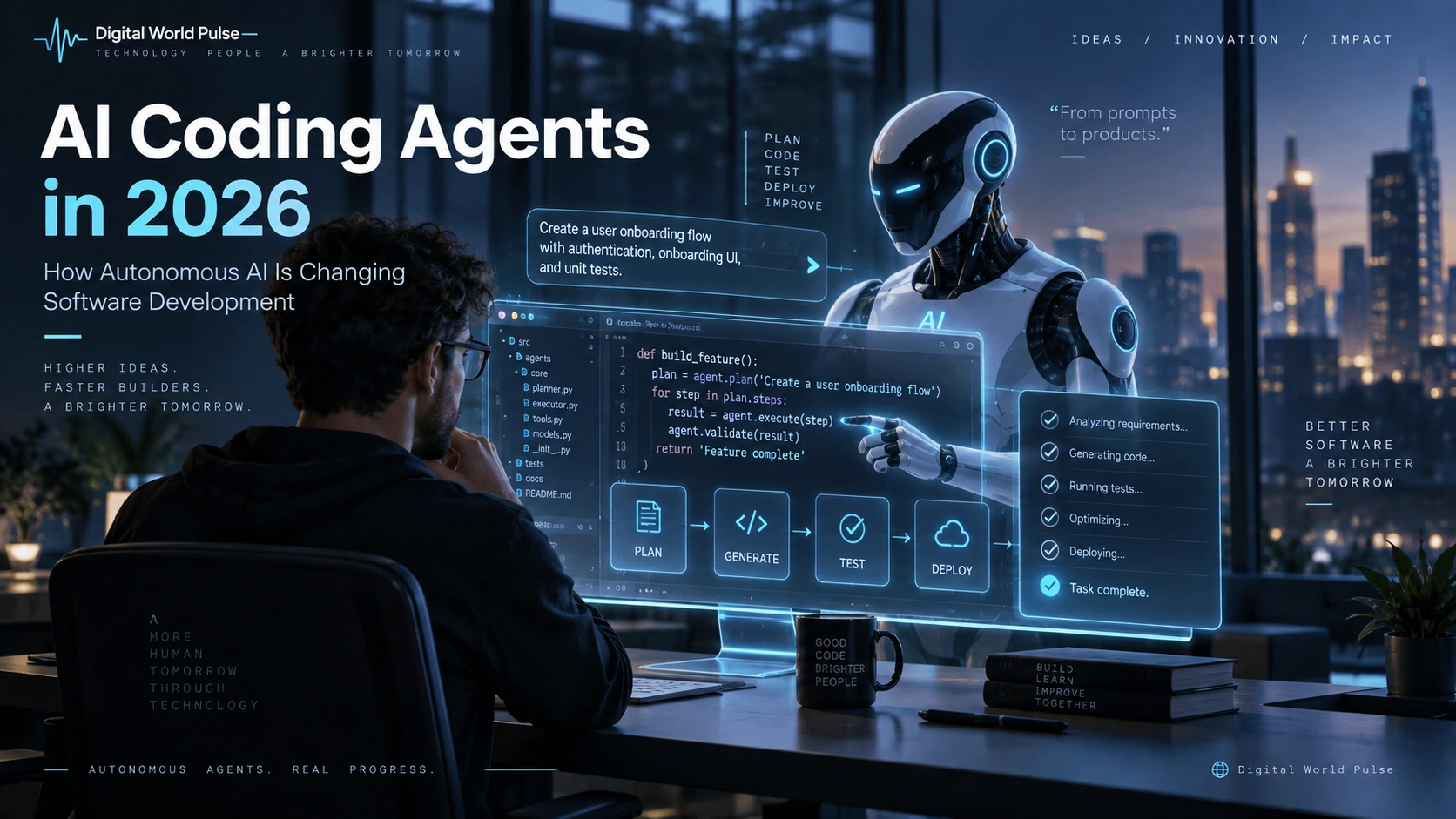
AI Coding Agents in 2026 are moving software development beyond simple autocomplete and chat-based coding assistance. The biggest change is not that AI suddenly writes perfect software by itself. It is that modern coding agents can increasingly understand a development objective, inspect repository context, plan several actions, modify files, run tools, test their own work, analyze failures and continue iterating while a developer supervises the process.
OpenAI describes Codex as an agentic coding system designed for end-to-end engineering tasks such as features, refactors and migrations, while GitHub documents agent workflows that can research repositories, plan changes and create pull requests for human review.
What Are AI Coding Agents in 2026?
AI Coding Agents in 2026 are software-development systems designed to maintain a goal across several connected actions.
A conventional coding assistant might explain an error, complete a function or generate a block of code. An autonomous coding agent can potentially receive a broader objective such as implementing a new authentication flow, inspect the repository, identify relevant modules, create a plan, modify several files, execute tests and react when something fails.
That continuity is the major difference.
The agent is no longer limited to producing code. It can participate in part of the engineering workflow.
OpenAI currently describes Codex as a coding agent capable of completing end-to-end engineering tasks including features, refactors and migrations, while also supporting parallel agent workflows.
GitHub documents a similar model. Copilot agent workflows can research repositories, create implementation plans, make code changes and prepare pull requests for developers to review.
If you want to improve the instructions you give these systems, our AI Coding Assistant Prompts guide provides structured prompts for coding, debugging, testing and development tasks.
From Coding Copilots to Autonomous Agents
The easiest way to understand AI Coding Agents in 2026 is to compare them with earlier coding assistants.
A copilot-style assistant usually reacts.
You ask for a function, explanation, test or refactor, and the tool responds. The developer decides what happens next.
An autonomous agent can continue through several steps.
For example, imagine this task:
Add a secure user onboarding flow with authentication, input validation, error handling and tests.
A basic coding assistant may immediately generate a solution.
A stronger agent workflow should first inspect the existing authentication system, understand project conventions, locate related services and tests, identify missing requirements and explain which files are likely to change.
Only after establishing that context should implementation begin.
This does not remove the developer from the process. It moves developer attention away from repetitive execution and toward requirements, architecture, review and higher-risk decisions.
For a broader introduction to this technology, our AI Agents for Beginners 2026 guide explains the relationship between AI agents, tools, context and human supervision.
Protect your connection while using AI coding tools, cloud IDEs, repositories, and developer platforms with NordVPN for added privacy and security on public or shared networks.
How AI Coding Agents Actually Work
A practical agent usually follows a loop rather than a single prompt-and-response interaction.
A useful development cycle looks like this:
Understand → Inspect → Plan → Execute → Test → Debug → Improve → Review
First, the agent interprets the task.
It should identify the objective, constraints and expected outcome. If the request leaves important product or technical questions unanswered, those uncertainties should be surfaced instead of silently invented.
Next comes repository inspection.
The agent can examine project structure, dependencies, configuration, existing implementations and related tests.
Planning follows.
Instead of immediately editing code, the agent determines which parts of the project are involved and creates a short sequence of actions.
Execution may then involve an editor, terminal, test runner, documentation, browser, APIs or other development tools.
Finally, validation determines whether the change actually works.
Practical Autonomous Coding Prompt
Act as a senior autonomous software engineer. First inspect the repository structure, relevant files, dependencies and coding conventions. Restate the development objective and identify any missing information or assumptions. Create a concise implementation plan before changing code. Execute the work in small steps, validate every meaningful change with appropriate tests or checks, investigate failures before modifying the implementation again, and finish with a structured summary of files changed, tests performed, unresolved risks and recommended next steps.
This gives the agent an engineering process instead of simply telling it to “write the code.”
Repository Context Can Matter More Than Code Generation
One of the most important lessons around AI Coding Agents in 2026 is that producing code quickly is not enough.
Software rarely exists as isolated files.
A feature can depend on shared utilities, authentication middleware, data models, environment variables, API contracts, configuration and existing tests.
An AI system that sees only one file can generate code that looks valid while breaking assumptions elsewhere in the application.
A repository-aware agent should understand:
- Main folders and modules
- Frameworks and dependencies
- Shared utilities
- API boundaries
- Data models
- Existing tests
- Configuration
- Coding conventions
- Similar implementations already in the project
Repository Analysis Prompt
Analyze this repository before making any changes. Map the important folders, frameworks, dependencies, shared utilities, API boundaries, data models, tests and coding conventions. Identify the files most likely to be affected by the requested change and explain how information flows between them. Highlight anything you cannot confirm before writing code.
This context-first approach also applies to information gathering. Our AI Research Assistant guide explains how stronger AI workflows begin with reliable context rather than unsupported assumptions.
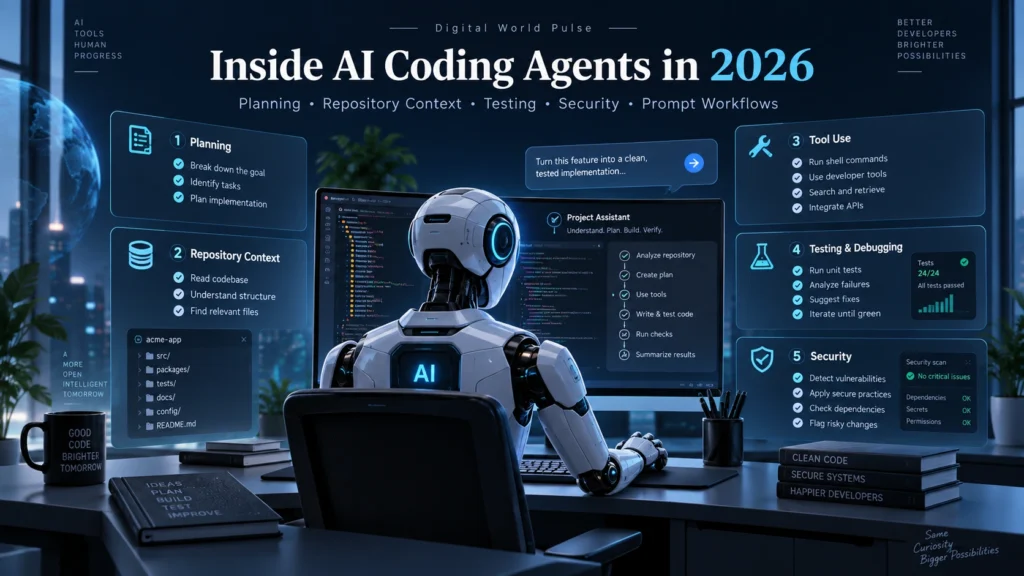
Planning and Tool Use Make Coding Agents More Capable
AI Coding Agents in 2026 become substantially more useful when reasoning is connected to development tools.
Depending on the task, an agent might work with:
- IDE or file editor
- Terminal
- Repository search
- Browser
- Official documentation
- Test runner
- APIs
- Databases
- Build systems
The agent should not automatically use every available tool.
It should choose the smallest set needed to complete the task safely.
A failing API endpoint might require logs, source files and tests.
A dependency migration may require package information, repository search and official documentation.
A frontend issue could require component code, browser behavior and visual verification.
Tool Selection Prompt
Before taking action, identify the minimum development tools required for this task. For each tool, explain why it is necessary and what result you expect from it. Use the tools in a logical order, record important findings and verify the result after every meaningful change. Do not perform destructive or production-level actions without explicit approval.
The same principle applies to larger automation systems. Our AI Workflow Designer guide covers how context, actions, validation and human review can be organized into repeatable workflows.
Testing, Debugging and Self-Correction
Testing is one of the areas where autonomous coding becomes genuinely useful.
Imagine an agent changes an API and runs the test suite:
24 tests passed
2 tests failed
A weak workflow would keep rewriting code until every test turns green.
A stronger workflow investigates the evidence.
The agent should read the failing assertions, trace the relevant execution path, create a root-cause hypothesis, make the smallest appropriate correction and run the affected tests again.
Only after the local problem is fixed should broader regression checks run.
Debugging Prompt
Treat every failing test as evidence rather than an obstacle. Read the complete error, identify the most likely root cause, inspect the related code paths and explain your hypothesis before changing anything. Apply the smallest safe fix, rerun the affected tests and then run the broader relevant test suite. Never disable, weaken or remove a test simply to make the build pass.
A useful loop becomes:
Detect → Investigate → Fix → Retest → Validate
Self-correction matters only when it is based on evidence.
Where AI Coding Agents Can Save the Most Time
AI Coding Agents in 2026 are particularly useful for development tasks that have a clear objective and an observable result.
Feature Development
An agent can locate similar functionality, identify affected modules, create an implementation plan, make changes and add tests.
Bug Investigation
Agents can combine logs, source code and test failures to help identify the cause of a defect before proposing a patch.
Code Refactoring
When tests protect existing behavior, agents can reorganize code incrementally and verify each stage.
Test Generation
Agents can identify missing edge cases and generate first-pass tests, although developers still need to determine whether those tests protect meaningful behavior.
Documentation
Repository-aware agents can draft documentation from current code rather than relying entirely on manually supplied context.
API Integration
An agent can compare existing service patterns with external documentation before creating an integration.
Legacy Modernization
Large migrations can be divided into smaller changes that are easier to validate and reverse if necessary.
The important question is not simply:
Can AI generate this code?
The stronger question is:
Can the result be reviewed, tested and verified reliably?
A Strong Feature Development Prompt
For larger development work, AI Coding Agents in 2026 need more structure than a one-line request.
Implement the requested feature as a senior software engineer. First restate the acceptance criteria and identify anything ambiguous. Inspect the existing architecture and locate similar implementations. Propose the smallest set of files that should change. Explain important design decisions before implementation. Build the feature incrementally, add or update meaningful tests, run relevant validation, review for security and regression risks, and finish with a concise report covering assumptions, files changed, tests run and unresolved concerns.
The instruction to modify the smallest necessary set of files matters because large automated edits are harder to understand and review.
🛠️ Explore More Software Tools
Discover practical software solutions for productivity, development, content, and digital workflows with Wondershare.
Explore Wondershare ToolsAffiliate disclosure: We may earn a commission if you purchase through this link, at no extra cost to you.
Security and Permissions Need Strict Boundaries
Greater autonomy also creates greater potential risk.
An AI coding agent with terminal or environment access may be able to install dependencies, modify configuration, read environment variables, execute scripts or interact with external services.
OpenAI has publicly described controls around Codex that emphasize defined access boundaries, human approval for higher-risk actions and telemetry that allows agent activity to be audited.
GitHub likewise describes agent environments and permission controls intended to support human oversight and safer execution.
This makes least-privilege access important.
An agent should receive only the permissions necessary for the current task.
Read-only repository access may be enough for analysis. Editing can happen inside an isolated branch or sandbox. Production deployments, infrastructure modifications, credential access and irreversible actions should remain behind explicit approval.
Security Review Prompt
Before executing this task, identify sensitive data, credentials, network access, privileged commands, external dependencies and destructive operations that may be involved. Recommend the minimum permissions required. Clearly separate actions that can be automated safely from actions that require explicit human approval. Stop before performing any production or irreversible operation.
Human Review Still Defines Software Quality
AI Coding Agents in 2026 can automate execution, but engineering judgment remains essential.
A test suite can confirm that code behaves according to existing expectations.
It cannot always determine whether those expectations represent the correct product decision.
An agent can generate a technically functional architecture that introduces unnecessary complexity.
Developers still need to evaluate:
- Architecture
- Maintainability
- Security
- Performance
- User impact
- Operational risk
- Edge cases
Senior Code Review Prompt
Act as an independent senior code reviewer. Evaluate this change for requirement coverage, correctness, architecture fit, maintainability, security, performance, test quality and regression risk. Do not assume the implementation is correct simply because tests pass. Separate blocking issues from optional improvements and identify every assumption that still requires human confirmation.
The strongest model is therefore supervised autonomy rather than invisible automation.
What Current Coding Platforms Show About the Future
The direction of current development tools is increasingly clear.
OpenAI says Codex can handle complete engineering tasks and parallel agent workflows rather than only generating isolated snippets. Developers who want to explore the platform directly can review the official OpenAI Codex page.
GitHub is moving in a similar direction. Its Copilot agent experiences can work through development tasks, inspect files, make edits, run commands, and iterate when problems occur. You can review the official GitHub Copilot agent documentation for more details.
These tools are different in implementation, but they point toward the same broader trend: software development is moving from isolated AI assistance toward more structured, supervised agent workflows.
AI Coding Agents in 2026: A Practical Strategy
The safest approach is not to give an agent unrestricted control over an entire development environment.
Start with a clearly defined task.
Give it enough repository context.
Require a short plan before modifications.
Limit permissions.
Make tool usage visible.
Require validation.
Review important changes.
Keep merge and deployment authority under human control.
Teams should also evaluate AI Coding Agents in 2026 by outcomes rather than demonstrations.
Useful measurements include:
- Development time saved
- Review effort
- Regression rate
- Test coverage
- Manual steps removed
- Security problems introduced
- Maintainability of generated code
The objective should not be maximum automation.
It should be better software development through controlled automation.
Why AI Coding Agents in 2026 Need Clear Development Rules
AI Coding Agents in 2026 can save time, but they work best when developers define clear rules before execution starts. The agent should know the task objective, which files it may inspect, which tools it can use and what actions require approval.
A good workflow for AI Coding Agents in 2026 also includes clear completion criteria. Instead of ending when code has simply been generated, the task should end only after relevant tests, checks and reviews have been completed.
This makes it easier to compare different autonomous AI coding agents because the evaluation is based on measurable development results rather than impressive demonstrations.
How Teams Can Evaluate AI Coding Agents in 2026
Teams testing AI Coding Agents in 2026 should measure more than raw development speed.
Useful signals include:
- time required to complete a task
- number of manual steps removed
- quality of generated tests
- number of review corrections required
- regressions introduced
- security issues discovered
- maintainability of the final implementation
A strong AI coding agents guide should therefore focus on repeatable workflows rather than promising that agents can replace experienced developers.
In practical AI software development 2026 workflows, the strongest systems are those that reduce repetitive work while still producing changes that developers can inspect and understand.
AI Coding Agents in 2026 Work Best With Small, Verifiable Tasks
AI Coding Agents in 2026 are generally easier to supervise when large objectives are divided into smaller development tasks.
Instead of asking an agent to rebuild an entire application, developers can assign one feature, one bug, one refactor or one integration at a time.
This creates shorter feedback loops.
The agent can inspect the relevant context, implement the change, run validation and return the result for review before moving to another part of the project.
That workflow also makes autonomous coding agents easier to debug because developers can identify exactly which automated step introduced a problem.
A Better Way to Use AI Coding Agents in 2026
The practical value of AI Coding Agents in 2026 comes from combining automation with engineering discipline.
The agent should receive enough context to work effectively, but permissions should remain limited to what the task actually requires.
Developers should also require structured output after each major task:
Objective → Plan → Files Changed → Tests Run → Issues Found → Remaining Risks
This structure helps teams understand what an AI system actually did instead of relying on a simple “task completed” message.
AI Coding Agents in 2026 become much more useful when every automated action can be reviewed, verified and connected to a clear engineering objective. AI Coding Agents in 2026 can deliver the most value when automation, testing, security, and human review work together inside a clear development process.

Get the AI Coding Agents in 2026 Premium Guide
The AI Coding Agents in 2026 Premium Guide expands the concepts in this article into a practical 20-page resource for developers, technical founders and anyone exploring autonomous development workflows.
It includes copy-ready prompts for repository analysis, feature development, debugging, testing, refactoring, security review and AI-assisted code review.
The guide also provides compact workflows covering planning, tool selection, repository understanding, permissions and validation.
The important material is not hidden behind the download. This article contains the core explanation and practical prompts, while the PDF works as an additional reference that can be reused during real development work.

Help Us Create More Valuable Resources
Digital World Pulse creates practical guides, in-depth analysis, useful tools, and downloadable resources available to everyone. Every article and resource requires time, research, hosting, and ongoing development.


If you found our content helpful, you can support our work through PayPal or Revolut. Your contribution is completely optional, and any amount—even the price of a coffee —helps us remain independent and continue creating useful, high-quality resources.
Thank you for supporting Digital World Pulse and helping us keep improving what we create.